


By using this site, you agree to the Privacy Policy and Terms of Use.
Accept
MedsparkMedsparkMedspark
  • Home
  • News & Alerts
    News & AlertsShow More
    Google’s TabFM Makes Accurate Predictions Without Fine-Tuning Per Dataset
    By
    msadmin
    July 12, 2026
    ARPA-H Awards $160 Million for AI-Enabled Personalized Gene Editing to Tackle Rare Diseases
    By
    msadmin
    July 12, 2026
    Linux Foundation opens health stack with AI commons backed by Google and Microsoft
    By
    msadmin
    July 12, 2026
    Michigan Medicine neuroimaging model outperforms GPT in brain scan analysis
    By
    msadmin
    July 12, 2026
    Machine Learning Links Children’s Screen Time to Distinct Metabolic Fingerprint and Heart Risk
    By
    msadmin
    July 7, 2026
  • Spotlight
    SpotlightShow More
    ARPA-H Awards $160 Million for AI-Enabled Personalized Gene Editing to Tackle Rare Diseases
    By
    msadmin
    July 12, 2026
    Strategic healthcare AI governance framework abstract illustration
    Building a Resilient Healthcare AI Strategy: Insights from Industry Leaders
    By
    msadmin
    May 15, 2026
    Pharma AI Alliance Expands: Owkin and AstraZeneca Deploy New Drug Discovery Models
    By
    msadmin
    May 14, 2026
    7 Must-Attend MedTech Events in South Africa for 2025
    By
    Jostel Owusu
    August 9, 2025
    EY Expert Urges Healthcare Leaders to Double Down on AI Amid Economic Uncertainty
    By
    Yu Chi Huang
    July 11, 2025
  • Articles
    ArticlesShow More
    Google’s TabFM Makes Accurate Predictions Without Fine-Tuning Per Dataset
    By
    msadmin
    July 12, 2026
    A doctor using an AI scribe system with a holographic transcription interface on a tablet in a modern clinic, showing ambient speech recognition and automated clinical documentation
    AI Scribe Adoption in Healthcare, From Ambient Listening to Autonomous Documentation
    By
    msadmin
    July 12, 2026
    A physician using a tablet with a glowing AI assistant hologram nearby, representing cognitive offloading in modern medicine with teal and gold futuristic lighting
    Understanding Cognitive Offloading in Modern Medicine
    By
    msadmin
    July 12, 2026
    AI-powered drug discovery concept showing a holographic molecular structure analyzed by neural networks in a sleek pharmaceutical laboratory with teal and gold lighting
    How Machine Learning Is Reshaping Pharmaceutical R&D
    By
    msadmin
    July 12, 2026
    Michigan Medicine neuroimaging model outperforms GPT in brain scan analysis
    By
    msadmin
    July 12, 2026
  • Events
    EventsShow More
    Stanford Health AI Week Highlights AI’s Growing Role in Medical Education, Patient Empowerment, and Life Sciences
    By
    msadmin
    June 19, 2026
    HIMSS APAC 2026: Re-engineering APAC Health Systems in the AI Era
    By
    msadmin
    June 9, 2026
    AIMed 2026: Bridging the Gap Between AI Promise and Clinical Reality in Kraków
    By
    msadmin
    April 30, 2026
    7 Must-Attend MedTech Events in South Africa for 2025
    By
    Jostel Owusu
    August 9, 2025
    Cleveland Clinic’s First AI Summit Signals Bold Future for Healthcare
    By
    msadmin
    July 19, 2025
  • About
    • Mission
    • Services
    • Contact
Font ResizerAa
MedsparkMedspark
Font ResizerAa
  • Home
  • News & Alerts
  • Spotlight
  • Articles
  • Events
  • About
  • Quick Links
    • Home
    • News & Alerts
    • Spotlight
    • Articles
    • Events
  • About MedSpark
    • Our Purpose & Vision
    • Services
    • Contact
Follow US
ArticlesSpotlight

Microsoft AI Outperforms Physicians in Complex Diagnostic Challenge With New MAI-DxO Tool

Yu Chi Huang
By
Yu Chi Huang
Yu Chi Huang
ByYu Chi Huang
Yu Chi is a senior regulatory affairs specialist and medical researcher focusing on medical devices.
Published: June 30, 2025
Share
3 Min Read
SHARE

As first reported by GeekWire, Microsoft has introduced the MAI-DxO (Microsoft AI Diagnostic Orchestrator), a cutting-edge artificial intelligence tool designed to tackle complex diagnostic challenges. In a head-to-head trial using 304 difficult cases from the New England Journal of Medicine, MAI-DxO achieved an 85.5% diagnostic accuracy rate — vastly outperforming a group of 21 U.S. and U.K. physicians, who correctly diagnosed only 20% of the same cases.

Contents
Designed to mimic clinical reasoning and reduce costsBeyond textbook knowledge: real-world diagnostic simulationNot a replacement, but an augmentation

Designed to mimic clinical reasoning and reduce costs

MAI-DxO approaches diagnosis much like a human clinician: it evaluates symptoms, asks questions, and suggests follow-up tests. One of its core advantages is its cost-conscious design, which helps reduce unnecessary diagnostics — a common driver of excess healthcare spending. Microsoft developed the system by integrating various top-tier AI models, with its most effective configuration running on OpenAI’s o3.
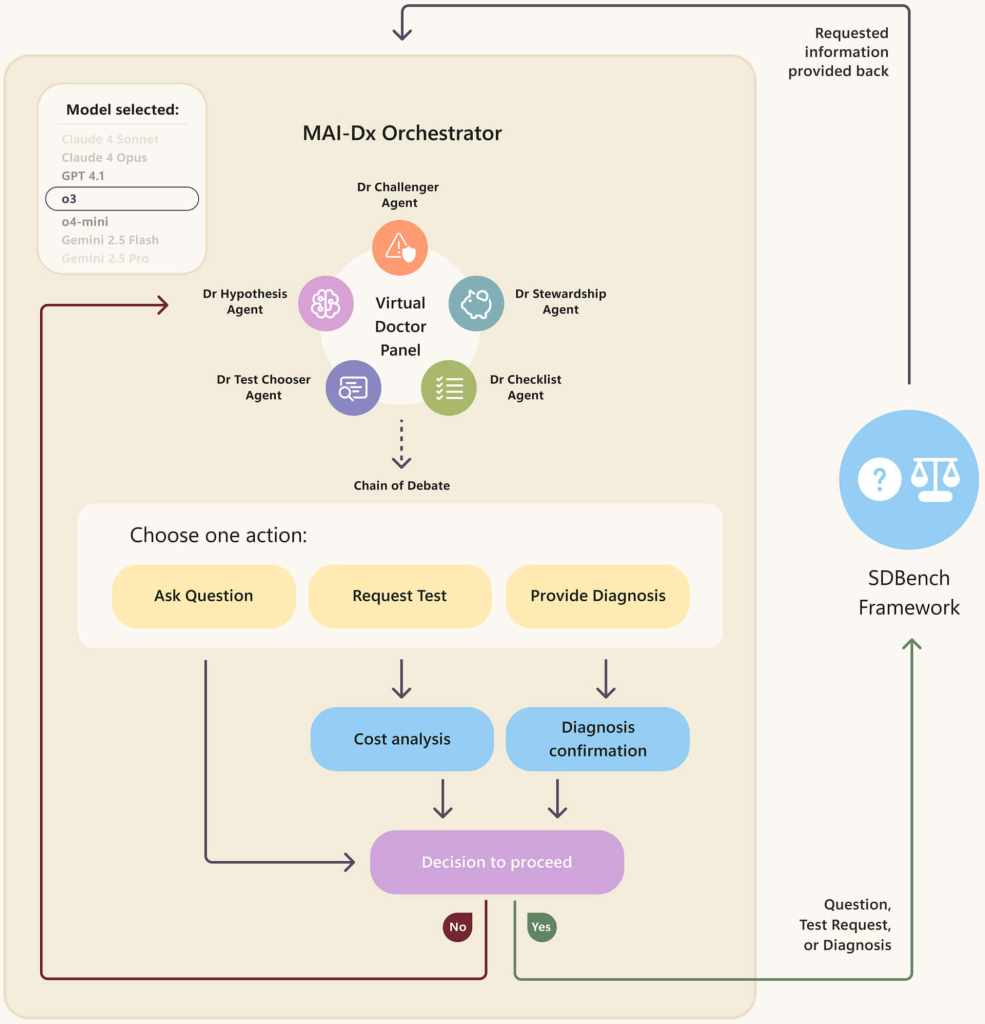
Source: microsoft.ai.

Beyond textbook knowledge: real-world diagnostic simulation

Unlike earlier benchmarks that relied on multiple-choice tests like the USMLE, this trial pushed MAI-DxO into the realm of “sequential diagnosis,” a process that mirrors how real physicians reach conclusions through iterative reasoning. Microsoft emphasized that the tool’s superior performance in these realistic scenarios is an indicator of how far AI in medicine has advanced, though it acknowledged that in real practice, doctors work collaboratively and use reference materials, which weren’t available in the test setup.

Not a replacement, but an augmentation

Microsoft leaders including CEO of Microsoft AI, Mustafa Suleyman, and VP of Health, Bay Gross, were clear in their vision: MAI-DxO isn’t meant to replace doctors but to augment them. The AI is positioned as a tool to assist in streamlining clinical workflows, guiding diagnoses, and creating personalized treatment strategies. The next phase will involve validating the system in clinical settings and against more routine medical cases, with regulatory approval required before deployment.

Microsoft’s MAI-DxO sets a new bar in AI-assisted diagnostics, showcasing the ability of advanced models to tackle complex, real-world medical reasoning tasks. As the company works toward clinical integration, its emphasis on responsible, collaborative AI suggests a future where human physicians and intelligent systems work hand in hand to enhance diagnostic accuracy and healthcare efficiency.


VIA:GeekWire
Share This Article
Facebook Copy Link Print
Yu Chi Huang
ByYu Chi Huang
Yu Chi is a senior regulatory affairs specialist and medical researcher focusing on medical devices.
banner-medspark-horiz

You Might Also Like

Articles

Designing Healthcare AI for Real World Clinical Flow

By
msadmin
June 30, 2026
Articles

NHS Unveils Radical 10-Year AI-Driven Plan to Transform Healthcare Delivery

By
Yu Chi Huang
July 8, 2025
EventsSpotlight

7 Must-Attend MedTech Events in South Africa for 2025

By
Jostel Owusu
August 9, 2025
Articles

ChatGPT Aids Rare Diagnosis as Tech Giants Accelerate AI Revolution in Healthcare

By
Yu Chi Huang
July 7, 2025
Facebook Twitter Youtube Linkedin
Quick Links
  • News & Alerts
  • Articles
  • Spotlight
  • Events
About Medspark
  • Mission
  • Services
  • Contact

© Copyright 2026 MedSpark. All rights reserved.

Privacy Policy | Legal