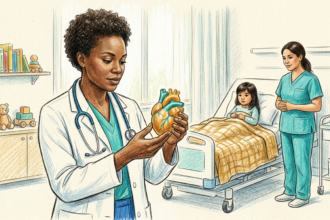


A Week of AI-Focused Symposia at Stanford Medicine
Stanford Medicine hosted its inaugural Health AI Week, an eight-symposium event covering the full spectrum of artificial intelligence in healthcare — from medical education and mental health to life sciences, medical imaging, and responsible AI deployment. The event brought together clinicians, researchers, educators, patients, and industry leaders to examine both the promises and the pitfalls of AI in medicine.
AI as a Patient Empowerment Tool
A recurring theme throughout the week was AI’s growing role in empowering patients. Sue Sheridan, president and CEO of Patients for Patient Safety US, shared how she used an AI-powered chatbot to diagnose her own Bell’s palsy after an emergency physician dismissed her symptoms. The chatbot correctly identified the condition and flagged the 72-hour treatment window, leading her to a second hospital where she received timely care that limited permanent paralysis.
Sheridan noted that millions of people lack timely access to clinicians and are already using AI “at the speed of desperation,” particularly in rural, underinsured, and mistrustful communities. Used thoughtfully, AI can give patients agency, language, and evidence to participate actively in their own care rather than remaining passive recipients of medical decisions.
The Never-Skilling Problem in Medical Education
At the AI in Medical Education symposium, a lively debate emerged around whether AI scribes — which record conversations and create patient summaries — should be used in residency training. Stanford physicians Tracy Rydel and Leonardo Aliaga debated the trade-off between reduced documentation burden and the risk of “never-skilling,” where trainees fail to develop critical clinical reasoning because AI handles the cognitive work.
A live audience poll showed support for AI scribes dropping from 69% to 54% after the debate, signaling growing caution about AI use during medical training. Speakers emphasized that while AI tools can reduce cognitive load, they must be deployed in ways that don’t prevent the development of independent clinical judgment.
AI and Cancer’s Evolutionary Challenge
At the AI in Life Sciences Symposium, Aviv Regev, head of Genentech Research, discussed how AI is poised to help cancer treatment systems evolve with the same agility as the disease itself. Cancer’s ability to adapt and develop resistance demands treatment approaches that can evolve in real time, and AI-driven analysis of genomic data, drug interactions, and treatment response patterns presents a promising path forward.
AI Across the Translational Spectrum
The week also featured symposia on AI in Mental Health, Responsible AI for Safe and Equitable (RAISE) Health, and the Artificial Intelligence in Medical Imaging (AIMI) series including dedicated pediatrics and academic-industry summits. Keynote speaker Laurah Turner from the University of Cincinnati opened the education symposium with a memorable story about her 9-year-old daughter using a homework chatbot to build a persuasive case for a toy, illustrating how AI is arming people of all ages with unexpected new capabilities.
Stanford Health AI Week demonstrated that the conversation around AI in medicine has matured beyond theoretical speculation into practical questions about deployment, training, equity, and patient partnership.
Source: Stanford Medicine