

By using this site, you agree to the Privacy Policy and Terms of Use.
Accept
MedsparkMedsparkMedspark
  • Home
  • News & Alerts
    News & AlertsShow More
    Anthropic Warning: Chip Export Limits Could Weaken Healthcare AI Access
    By
    msadmin
    May 21, 2026
    Pharma AI Alliance Expands: Owkin and AstraZeneca Deploy New Drug Discovery Models
    By
    msadmin
    May 14, 2026
    Pennsylvania Targets AI Chatbots That Pose as Licensed Doctors
    By
    msadmin
    May 5, 2026
    M42 and GE HealthCare Partner to Advance AI-Driven Smart Healthcare in the UAE
    By
    Yu Chi Huang
    July 14, 2025
    HL7 Launches Dedicated AI Office to Drive Global Standards for Ethical Healthcare Innovation
    By
    Yu Chi Huang
    July 8, 2025
  • Spotlight
    SpotlightShow More
    Strategic healthcare AI governance framework abstract illustration
    Building a Resilient Healthcare AI Strategy: Insights from Industry Leaders
    By
    msadmin
    May 15, 2026
    Pharma AI Alliance Expands: Owkin and AstraZeneca Deploy New Drug Discovery Models
    By
    msadmin
    May 14, 2026
    EY Expert Urges Healthcare Leaders to Double Down on AI Amid Economic Uncertainty
    By
    Yu Chi Huang
    July 11, 2025
    Medow Health AI Launches Real-Time AI Scribe in Singapore to Boost Clinical Efficiency
    By
    Yu Chi Huang
    July 4, 2025
    Guangdong Medical University Launches China’s First AI Medical School to Lead Future Healthcare Education
    By
    Yu Chi Huang
    July 2, 2025
  • Articles
    ArticlesShow More
    Strategic healthcare AI governance framework abstract illustration
    Building a Resilient Healthcare AI Strategy: Insights from Industry Leaders
    By
    msadmin
    May 15, 2026
    Gene Editing Breakthroughs and AI Risks: A Health Sector View of 2026’s Defining Tech
    By
    msadmin
    May 12, 2026
    Bridging the Gap Between AI Adoption and HIPAA Compliance
    By
    msadmin
    May 6, 2026
    EY Expert Urges Healthcare Leaders to Double Down on AI Amid Economic Uncertainty
    By
    Yu Chi Huang
    July 11, 2025
    Google Unveils Open-Source Medical AI Models That See, Read, and Assist Like Real Clinicians
    By
    Yu Chi Huang
    July 10, 2025
  • Events
    EventsShow More
    Cleveland Clinic’s First AI Summit Signals Bold Future for Healthcare
    By
    msadmin
    July 19, 2025
    Experts Urge Cautious Adoption of Agentic AI in Healthcare Workflows at HIMSS AI Forum
    By
    Yu Chi Huang
    July 11, 2025
    New Zealand Accelerates Healthcare Innovation With AI and 24/7 Virtual Care Services
    By
    Yu Chi Huang
    July 7, 2025
    Aidoc and Nvidia Launch BRIDGE to Streamline and Scale Safe Clinical AI Adoption
    By
    Yu Chi Huang
    June 18, 2025
    UK’s Brightest AI4Health Researchers Shine at National Doctoral Conference in York
    By
    msadmin
    June 11, 2025
  • About
    • Mission
    • Services
    • Contact
Font ResizerAa
MedsparkMedspark
Font ResizerAa
  • Home
  • News & Alerts
  • Spotlight
  • Articles
  • Events
  • About
  • Quick Links
    • Home
    • News & Alerts
    • Spotlight
    • Articles
    • Events
  • About MedSpark
    • Our Purpose & Vision
    • Services
    • Contact
Follow US
Articles

HKUST Pioneers Micro-Robotics and AI Tools to Reshape Global Healthcare

From ultra-miniature surgical robots to gamified respiratory monitors, HKUST is redefining medical technology with innovations that blend precision, interactivity, and AI.

Yu Chi Huang
By
Yu Chi Huang
Yu Chi Huang
ByYu Chi Huang
Yu Chi is a senior regulatory affairs specialist and medical researcher focusing on medical devices.
Published: July 2, 2025
Share
3 Min Read
SHARE

As first reported by OpenGov Asia, healthcare systems worldwide are struggling to keep pace with the demands of ageing populations and rising chronic illness. In response, researchers at the Hong Kong University of Science and Technology (HKUST) are advancing a new wave of medical technologies that combine robotics and artificial intelligence (AI). Their latest breakthroughs span surgical precision, rehabilitation assessment, and home-based respiratory monitoring — all designed to improve patient care while supporting clinicians.

Contents
Ultra-small surgical robot expands access and precisionAI-driven tools for rehabilitation and respiratory careHuman-centric design meets future-forward healthcare

Source: innovationhub.hk.

Ultra-small surgical robot expands access and precision

One of HKUST’s standout innovations is an ultra-miniaturised surgical robot with a diameter of just 0.95 millimetres—small enough to navigate tight, delicate spaces in the human body like bronchial or fallopian tubes. Despite its size, the robot is a fully capable surgical assistant, integrating imaging, navigation, drug delivery, and thermal therapy capabilities. Its compact form factor not only reduces invasiveness but opens new possibilities for minimally invasive procedures in previously unreachable anatomical areas.

AI-driven tools for rehabilitation and respiratory care

HKUST’s second innovation, PhyTac, is a cone-shaped handgrip embedded with 368 sensors that mirrors the spiral pattern of Aloe polyphylla. Designed to track motor recovery in patients, especially those undergoing stroke or neurological rehabilitation, the device uses AI to detect subtle changes in grip strength and force distribution, allowing clinicians to assess recovery in real time with greater accuracy than traditional methods.
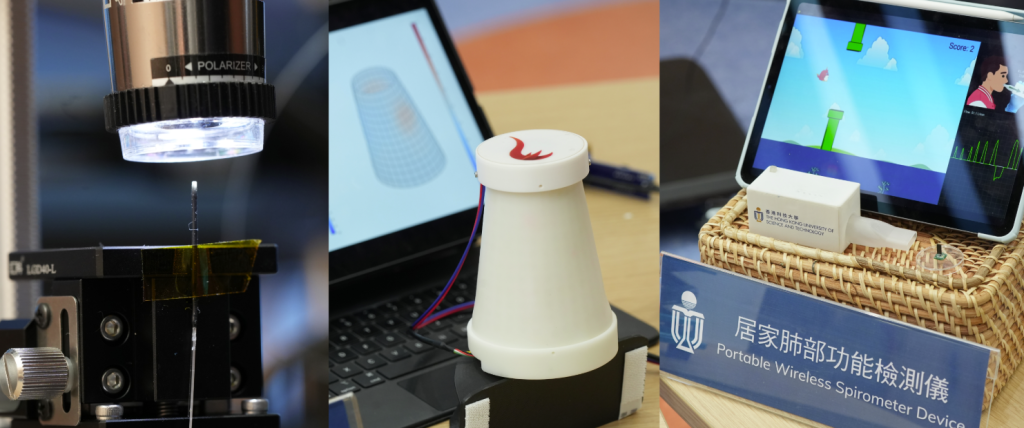
Source: hkust.edu.hk.

The third device addresses a post-pandemic focus on respiratory health: a portable, 78-gram wireless spirometer that combines clinical utility with user engagement. The system’s gamified interface—in which users control a virtual bird by breathing—encourages regular use while collecting data for remote monitoring by healthcare providers. This not only enhances compliance but also makes routine testing more engaging and accessible.

Human-centric design meets future-forward healthcare

These devices underscore HKUST’s commitment to developing intelligent tools that merge technical excellence with practical usability. By focusing on miniaturisation, AI-powered sensing, and user-friendly interfaces, the researchers are creating medical technologies that fit seamlessly into both clinical environments and patients’ daily lives.

HKUST’s innovations represent a broader shift in healthcare towards collaboration between humans and intelligent machines. By enhancing the precision, awareness, and accessibility of medical devices, their work not only meets urgent global health needs but also sets a precedent for how robotics and AI can humanise, rather than replace, modern medicine.

TAGGED:editor-pick
VIA:OpenGov Asia
Share This Article
Facebook Copy Link Print
Yu Chi Huang
ByYu Chi Huang
Yu Chi is a senior regulatory affairs specialist and medical researcher focusing on medical devices.
banner-medspark-horiz

You Might Also Like

Strategic healthcare AI governance framework abstract illustration
ArticlesSpotlight

Building a Resilient Healthcare AI Strategy: Insights from Industry Leaders

By
msadmin
May 15, 2026
Articles

AI Scribes Ease Clinician Burden but Raise Privacy and Safety Concerns in Australia’s Hospitals

By
Yu Chi Huang
July 7, 2025
Articles

AI Emerges as a Game-Changer in Humanitarian Healthcare Crisis Response

By
Yu Chi Huang
July 4, 2025
Articles

ChatGPT Aids Rare Diagnosis as Tech Giants Accelerate AI Revolution in Healthcare

By
Yu Chi Huang
July 7, 2025
Facebook Twitter Youtube Linkedin
Quick Links
  • News & Alerts
  • Articles
  • Spotlight
  • Events
About Medspark
  • Mission
  • Services
  • Contact

Subscribe to the MedSpark AI newsletter

Sign up now and don’t miss a single healthcare and medical AI update.

© Copyright 2026 MedSpark. All rights reserved.

Privacy Policy | Legal