
By using this site, you agree to the Privacy Policy and Terms of Use.
Accept
MedsparkMedsparkMedspark
  • Home
  • News & Alerts
    News & AlertsShow More
    Google’s TabFM Makes Accurate Predictions Without Fine-Tuning Per Dataset
    By
    msadmin
    July 12, 2026
    ARPA-H Awards $160 Million for AI-Enabled Personalized Gene Editing to Tackle Rare Diseases
    By
    msadmin
    July 12, 2026
    Linux Foundation opens health stack with AI commons backed by Google and Microsoft
    By
    msadmin
    July 12, 2026
    Michigan Medicine neuroimaging model outperforms GPT in brain scan analysis
    By
    msadmin
    July 12, 2026
    Machine Learning Links Children’s Screen Time to Distinct Metabolic Fingerprint and Heart Risk
    By
    msadmin
    July 7, 2026
  • Spotlight
    SpotlightShow More
    ARPA-H Awards $160 Million for AI-Enabled Personalized Gene Editing to Tackle Rare Diseases
    By
    msadmin
    July 12, 2026
    Strategic healthcare AI governance framework abstract illustration
    Building a Resilient Healthcare AI Strategy: Insights from Industry Leaders
    By
    msadmin
    May 15, 2026
    Pharma AI Alliance Expands: Owkin and AstraZeneca Deploy New Drug Discovery Models
    By
    msadmin
    May 14, 2026
    7 Must-Attend MedTech Events in South Africa for 2025
    By
    Jostel Owusu
    August 9, 2025
    EY Expert Urges Healthcare Leaders to Double Down on AI Amid Economic Uncertainty
    By
    Yu Chi Huang
    July 11, 2025
  • Articles
    ArticlesShow More
    Google’s TabFM Makes Accurate Predictions Without Fine-Tuning Per Dataset
    By
    msadmin
    July 12, 2026
    A doctor using an AI scribe system with a holographic transcription interface on a tablet in a modern clinic, showing ambient speech recognition and automated clinical documentation
    AI Scribe Adoption in Healthcare, From Ambient Listening to Autonomous Documentation
    By
    msadmin
    July 12, 2026
    A physician using a tablet with a glowing AI assistant hologram nearby, representing cognitive offloading in modern medicine with teal and gold futuristic lighting
    Understanding Cognitive Offloading in Modern Medicine
    By
    msadmin
    July 12, 2026
    AI-powered drug discovery concept showing a holographic molecular structure analyzed by neural networks in a sleek pharmaceutical laboratory with teal and gold lighting
    How Machine Learning Is Reshaping Pharmaceutical R&D
    By
    msadmin
    July 12, 2026
    Michigan Medicine neuroimaging model outperforms GPT in brain scan analysis
    By
    msadmin
    July 12, 2026
  • Events
    EventsShow More
    Stanford Health AI Week Highlights AI’s Growing Role in Medical Education, Patient Empowerment, and Life Sciences
    By
    msadmin
    June 19, 2026
    HIMSS APAC 2026: Re-engineering APAC Health Systems in the AI Era
    By
    msadmin
    June 9, 2026
    AIMed 2026: Bridging the Gap Between AI Promise and Clinical Reality in Kraków
    By
    msadmin
    April 30, 2026
    7 Must-Attend MedTech Events in South Africa for 2025
    By
    Jostel Owusu
    August 9, 2025
    Cleveland Clinic’s First AI Summit Signals Bold Future for Healthcare
    By
    msadmin
    July 19, 2025
  • About
    • Mission
    • Services
    • Contact
Font ResizerAa
MedsparkMedspark
Font ResizerAa
  • Home
  • News & Alerts
  • Spotlight
  • Articles
  • Events
  • About
  • Quick Links
    • Home
    • News & Alerts
    • Spotlight
    • Articles
    • Events
  • About MedSpark
    • Our Purpose & Vision
    • Services
    • Contact
Follow US
News & Alerts

AAMI Adopts National Academy of Medicine’s AI Code of Conduct to Guide Ethical Use in Medical Devices

The efforts align with the NAM’s AI Code of Conduct to support ethical, equitable, and effective AI integration in health technology.

Yu Chi Huang
By
Yu Chi Huang
Yu Chi Huang
ByYu Chi Huang
Yu Chi is a senior regulatory affairs specialist and medical researcher focusing on medical devices.
Published: July 3, 2025
Share
3 Min Read
SHARE

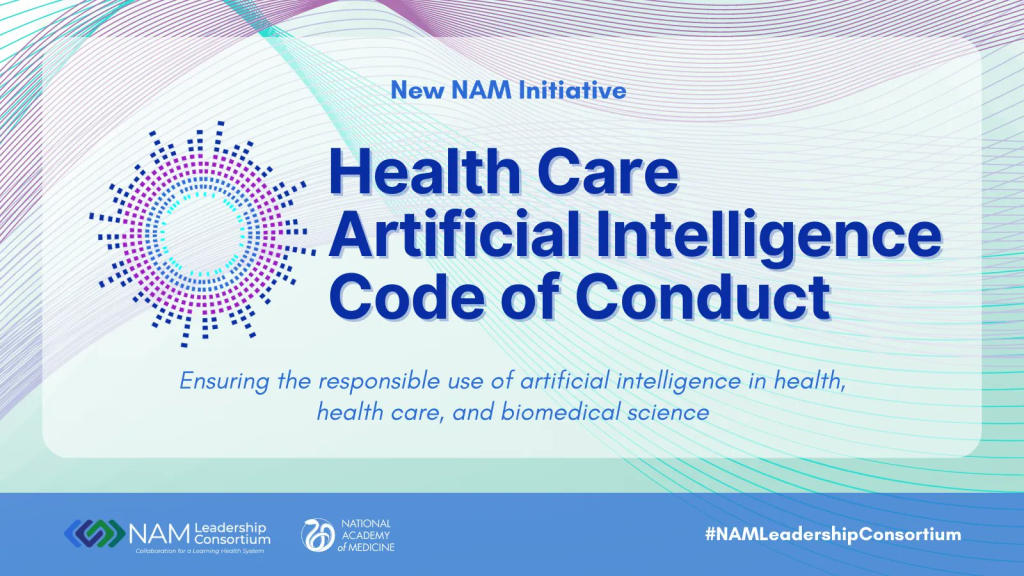
As first reported by GlobeNewswire, the Association for the Advancement of Medical Instrumentation (AAMI) has announced its formal alignment with the National Academy of Medicine’s (NAM) newly released AI Code of Conduct for Health and Medicine. This 189-page document lays out six foundational commitments for the ethical development and deployment of artificial intelligence in the medical field. AAMI plans to leverage the Code across its standards-setting, education, and certification work to ensure AI in medical devices is safe, effective, and equitable.
Contents
Six commitments guiding responsible AISupporting standards and sector-wide adoptionCollaborative effort led by industry leaders

Source: x.com/theNAMedicine.

Six commitments guiding responsible AI

The Code of Conduct emphasizes six guiding principles: Advance Humanity, Ensure Equity, Engage Impacted Individuals, Improve Workforce Well-Being, Monitor Performance, and Innovate and Learn. These commitments serve as a practical framework for evaluating AI technologies across the healthcare sector. AAMI’s Chief Learning and Development Officer, Robert Burroughs, noted the Code’s potential to unify and inform AAMI’s efforts, offering members and stakeholders a shared ethical foundation as AI becomes increasingly central to medical device innovation.

Supporting standards and sector-wide adoption

AAMI Vice President of Standards, Matt Williams, highlighted the Code’s utility in supporting the development of regulatory-ready guidance documents, especially as AAMI committees address the fast-evolving AI landscape. The organization also plans to produce an executive summary of the AICC later this year to make the 189-page document more accessible. To further facilitate adoption, NAM’s Senior Advisor Laura Adams authored a companion guide titled Why and How to Use the NAM AICC, aimed at helping organizations navigate and apply the Code effectively.

Collaborative effort led by industry leaders

The AICC was the result of a robust, expert-driven review process that included contributions from leading figures in the field, such as Bakul Patel, Google’s Senior Director of Global Digital Health Strategy and AAMI board member, and Pat Baird, Regulatory Head of Global Software Standards at Philips. Their involvement, alongside AAMI leadership like Timothy Hsu, reflects a collaborative approach to establishing meaningful and practical AI governance in healthcare.

With its adoption of the NAM AI Code of Conduct, AAMI is taking a proactive role in shaping the ethical integration of AI in medical technology. By aligning with a clear and actionable framework, the organization reinforces its commitment to safety, innovation, and equity in a field where the responsible use of AI is critical to public trust and clinical impact.
VIA:GlobalNewswire
Share This Article
Facebook Copy Link Print
Yu Chi Huang
ByYu Chi Huang
Yu Chi is a senior regulatory affairs specialist and medical researcher focusing on medical devices.
banner-medspark-horiz

You Might Also Like

News & Alerts

AI Model Generates Future Knee X-Rays to Predict Osteoarthritis Progression

By
msadmin
July 1, 2026
News & Alerts

 UK Becomes First Pioneer in Global AI Health Regulation Network

By
Yu Chi Huang
June 25, 2025
News & Alerts

Mater Hospital Launches AI Center to Accelerate Heart Attack Diagnosis and Revolutionise Patient Care

By
Yu Chi Huang
June 17, 2025
EventsNews & Alerts

Aidoc and Nvidia Launch BRIDGE to Streamline and Scale Safe Clinical AI Adoption

By
Yu Chi Huang
June 18, 2025
Facebook Twitter Youtube Linkedin
Quick Links
  • News & Alerts
  • Articles
  • Spotlight
  • Events
About Medspark
  • Mission
  • Services
  • Contact

© Copyright 2026 MedSpark. All rights reserved.

Privacy Policy | Legal