
From Single AI Tools to Coordinated Agent Workforces
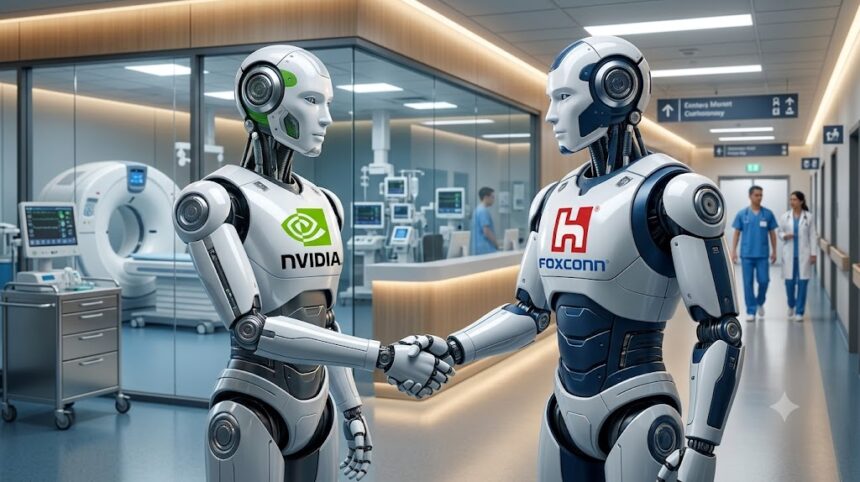
NVIDIA, Foxconn, and Taiwan’s leading medical centers announced at GTC Taipei a major expansion of agentic and physical AI deployment across the region’s healthcare system. The initiative transitions hospitals from using standalone AI tools to coordinated teams of specialized AI agents that reason, document, and orchestrate care alongside clinicians.
Taiwan faces one of the world’s fastest-aging populations, creating mounting pressure on clinical workforce capacity. Foxconn’s CoDoctor AI platform now brings together a coordinated team of domain-specific AI agents covering cardiovascular care, oncology, ophthalmology, and more. These agents operate continuously, helping clinicians reason through complex diagnoses, manage documentation, and coordinate care across departments.
New AI Agents for Clinical Workflows
Foxconn introduced several new specialized agents within CoDoctor AI:
- ECG AI Agent — An AI-based EKG screening system that helps hospitals triage cardiac patients more efficiently by flagging abnormalities in real time.
- Corovia AI Agent — Automatically reconstructs the heart and coronary arteries in 3D, compressing a two-hour clinical workflow down to just one minute for faster surgical planning and diagnosis.
- Endovia AI Agent — An AI-powered colonoscopy solution supporting real-time lesion detection with millisecond-level edge inference during procedures.
These agents are powered by NVIDIA Nemotron open models, which deliver clinical reasoning and real-time multimodal capabilities while giving healthcare institutions full control over their model weights.
CoDoClaw: Multi-Agent Orchestration Platform
Foxconn also introduced CoDoClaw, a clinical intelligent agent system built on NVIDIA NemoClaw, an open-source blueprint for deploying autonomous agents. CoDoClaw advances CoDoctor AI from standalone tools into a multi-agent orchestration platform capable of coordinating AI agents across breast cancer screening, ECG analysis, fundus imaging, and coronary artery analysis through a single unified clinical interface. NVIDIA OpenShell provides additional privacy and security controls for patient data.
Physical AI: Surgical and Nursing Robots
Beyond digital agents, AI agent workforces are operating in physical hospital spaces. Foxconn’s new Scrub Bot, an AI-enhanced scrub nurse collaborative robot, operates in live surgical suites. It responds to surgeon voice commands and adapts in real time to the rapidly changing needs of an operating room.
Foxconn’s Nurabot nursing collaborative robot, powered by NVIDIA’s physical AI stack, completed field validation at Taichung Veterans General Hospital and has expanded to additional sites including Taipei Veterans General Hospital and Tungs’ Taichung MetroHarbor Hospital. By handling transport and logistics tasks, Nurabot frees an estimated two to three hours per day for frontline nurses to focus on direct patient care. Foxconn is also piloting NemoClaw integration in future Nurabot deployments to enhance intelligent collaboration.
NVIDIA’s Agent-Ready Rheo blueprint within NVIDIA Isaac for Healthcare is being used to automate simulation-to-real pipelines for hospital robot development, from scene reconstruction to policy training and deployment.
Digital Twins Cut Deployment Time by 40%
Foxconn builds NVIDIA Omniverse-powered digital twins of hospital facilities before bringing robots into real clinical settings. These virtual replicas allow AI and robotic systems to be tested, trained, and validated in simulation first. Foxconn reports this simulation-first approach has cut deployment time by 40% and achieved 98% navigation accuracy.
$1.5 Billion Healthy Taiwan Initiative
The efforts fall under the Taiwan government’s “Healthy Taiwan” initiative, a $1.5 billion commitment to build a sovereign, regulated AI-native health system spanning clinical hospitals, academic institutions, and technology companies. Foxconn serves as the ecosystem integrator, connecting government programs, hospitals, device makers, and software companies.
“The next era of healthcare is being powered by agentic AI — teams of digital and physical AI agents working alongside clinicians,” said Kimberly Powell, vice president of healthcare at NVIDIA. “Together with Foxconn and Taiwan’s leading medical centers, NVIDIA is accelerating the deployment of AI infrastructure that helps clinical teams, improves hospital efficiency, and creates a model for health systems around the world.”
Barry Chiang, president of B group and Digital Health at Foxconn, emphasized the company’s role in building the AI infrastructure and clinical platforms to connect hospitals, medical devices, and software innovators across Taiwan.
Health Ministry Launches AI Compute Center and Federated Learning Program
On the same day as the GTC Taipei healthcare announcements, Taiwan’s Ministry of Health and Welfare launched its new AI Compute Center and International Federated Learning Program — a major step toward integrating AI into the island’s healthcare infrastructure. The initiative responds to the Cabinet’s “New Ten Major AI Construction Projects,” focusing on smart applications, core technologies, and digital infrastructure.
Health Minister Shih Chung-liang said the program has been under development since 2024 and has already improved internal AI services, including the 1966 smart customer service system and document error checking. Under the federated learning model, AI models are trained across hospital sites without patient data leaving individual institutions. “We build an AI model, and when verifying it, we send the model to each hospital for computation. Afterward, the results are sent back,” Shih said. “The hospitals’ medical records and personal data do not need to be uploaded to the cloud. The model is verified locally and then integrated at the computing center.”
The platform connects data from 16 Taiwanese hospitals and has expanded international collaborations with Thailand’s Mahidol University and Sweden’s Karolinska University Hospital. Thailand’s projects focus on breast cancer imaging and tuberculosis X-ray analysis, representing early practical applications of cross-border federated learning in medical imaging.
Sources: NVIDIA Newsroom, Radio Taiwan International