

How Optical Computing Accelerates AI Processing
Researchers at Tsinghua University have developed a groundbreaking optical processor called the Optical Feature Extraction Engine (OFE2) that operates at 12.5 GHz using light instead of electricity. This device overcomes the physical limitations of traditional electronic chips by performing matrix-vector multiplications in just 250.5 picoseconds, the fastest known result for this type of optical computation. The system uses integrated diffraction operators and a novel data preparation module that converts serial data into synchronized optical channels while maintaining phase stability, solving one of the most challenging problems in optical computing.
Applications in Medical Imaging and Clinical Decision Making
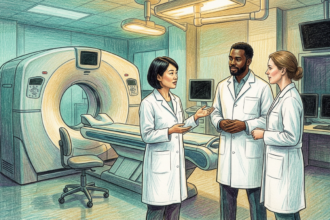
The OFE2 engine demonstrated significant impact in healthcare applications, particularly in medical image analysis. When applied to CT scans, the system successfully extracted edge features from visual data, creating detailed relief and engraving maps that improved image classification accuracy. These optical preprocessing capabilities allowed AI models to identify organs in medical scans with greater precision while requiring fewer electronic parameters than standard approaches. This hybrid optical-electronic approach could enable real-time analysis of streaming medical imaging data during procedures such as robotic surgery.
Implications for Real Time Healthcare AI
The optical engine’s ability to process data at unprecedented speeds with lower power consumption positions it as a transformative technology for time sensitive medical applications. By moving the most computationally demanding parts of AI processing from power hungry electronic chips to photonic systems, OFE2 could enable real time clinical decision support, rapid diagnostic imaging analysis, and instantaneous processing of patient monitoring data. The researchers emphasize that this work provides a foundation for compute intensive services in assisted healthcare, opening possibilities for faster and more energy efficient AI systems in clinical settings.
Source: Sciencedaily