
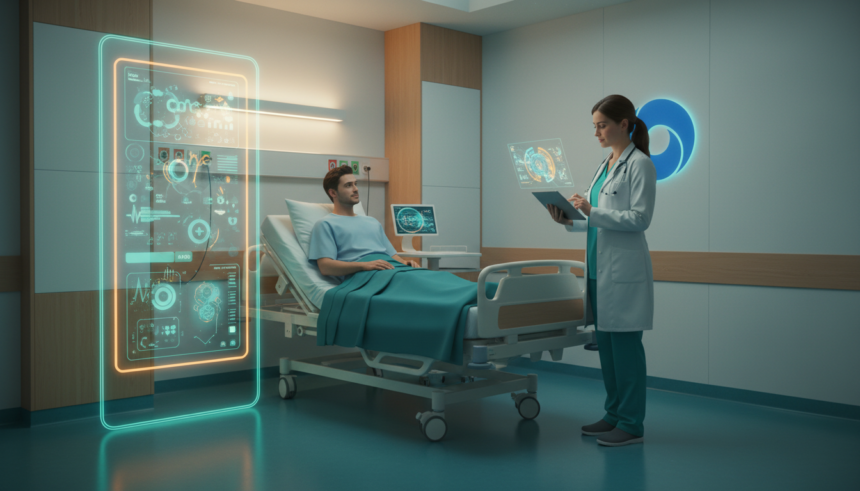
Google DeepMind has unveiled its AI co-clinician research initiative, a new framework designed to amplify physicians’ expertise through collaborative AI agents. The model, called triadic care, positions AI as a team member that interacts with patients under direct clinical supervision rather than operating independently.
In blind evaluations of 98 realistic primary care queries, physicians consistently preferred the AI co-clinician’s responses over leading evidence synthesis tools. The system recorded zero critical errors in 97 of those cases, outperforming two AI systems already used by clinicians. DeepMind also tested the model on the OpenFDA RxQA medication benchmark, where it surpassed other frontier AI systems in open-ended medication reasoning tasks.
The research builds on DeepMind’s earlier work with MedPaLM, AMIE, and the NOHARM evaluation framework, which measures errors of commission and omission. Beyond clinician-facing tools, the team is also exploring the model’s real-time multimodal capabilities in telemedical settings, recognizing that subtle visual and auditory cues are essential for thorough clinical assessment.
DeepMind is advancing phased evaluations with academic partners across the US, India, Australia, Singapore, and the UAE. The initiative responds to a projected global shortage of 10 million health workers by 2030.