By using this site, you agree to the Privacy Policy and Terms of Use.
Accept
MedsparkMedsparkMedspark
  • Home
  • News & Alerts
    News & AlertsShow More
    South Korea plans AI and smart sensors to staff around-the-clock elder care
    South Korea plans AI and smart sensors to staff around-the-clock elder care
    By
    msadmin
    October 12, 2026
    Aiforia and PathAI open a shared storefront for pathology algorithms
    Aiforia and PathAI open a shared storefront for pathology algorithms
    By
    msadmin
    October 12, 2026
    Smart toilet sensor matches gastroenterologists at sorting stool samples
    Smart toilet sensor matches gastroenterologists at sorting stool samples
    By
    msadmin
    October 12, 2026
    Fujifilm ships a pathology software overhaul with its own AI foundation model
    Fujifilm ships a pathology software overhaul with its own AI foundation model
    By
    msadmin
    October 12, 2026
    Lunit pushes its pathology AI into drug trials through a US lab deal
    Lunit takes pathology AI into drug research with US lab pact
    By
    msadmin
    October 12, 2026
  • Spotlight
    SpotlightShow More
    Robinhood Ventures Fund II brings retail capital to healthcare AI
    By
    msadmin
    August 13, 2026
    Adialante brings accessible MRI-based cancer screening
    By
    msadmin
    August 11, 2026
    CellType models biology so AI can discover drugs
    By
    msadmin
    August 11, 2026
    Healthcare AI startups in Robinhood Ventures Fund II
    By
    msadmin
    August 11, 2026
    OpenAI launches GPT-Rosalind for life sciences research
    By
    msadmin
    July 17, 2026
  • Articles
    ArticlesShow More
    Proteomics model picks breast cancer drugs from biopsies
    By
    msadmin
    September 10, 2026
    CRISP model reads frozen sections to steer cancer surgery
    By
    msadmin
    September 10, 2026
    Consumer chatbots are building a medical system outside hospitals
    By
    msadmin
    August 21, 2026
    Reasoning gaps hold back AI agents in scientific discovery
    By
    msadmin
    August 11, 2026
    Benchmark scores can’t track real clinical LLM use, Stanford says
    By
    msadmin
    August 11, 2026
  • About
    • Mission
    • Services
    • Contact
  • Shop
    • All Items
    • By Category
    • Cart
  • Newsletter
Font ResizerAa
MedsparkMedspark
Font ResizerAa
  • Home
  • News & Alerts
  • Spotlight
  • Articles
  • About
  • Shop
  • Newsletter
  • Home
  • News & Alerts
  • Spotlight
  • Articles
  • About
    • Mission
    • Services
    • Contact
  • Shop
    • All Items
    • By Category
    • Cart
  • Newsletter
Follow US
News & Alerts

KAIST’s K-Fold model predicts drug-protein binding 25x faster

KAIST's homegrown K-Fold model predicts protein-drug binding structures up to 25 times faster than existing AI.

MedSpark Staff
By
msadmin
MedSpark Staff
Bymsadmin
Medical, Healthcare, & Biotech/Pharma AI News
Follow:
Published: August 28, 2026
Share
2 Min Read
SHARE

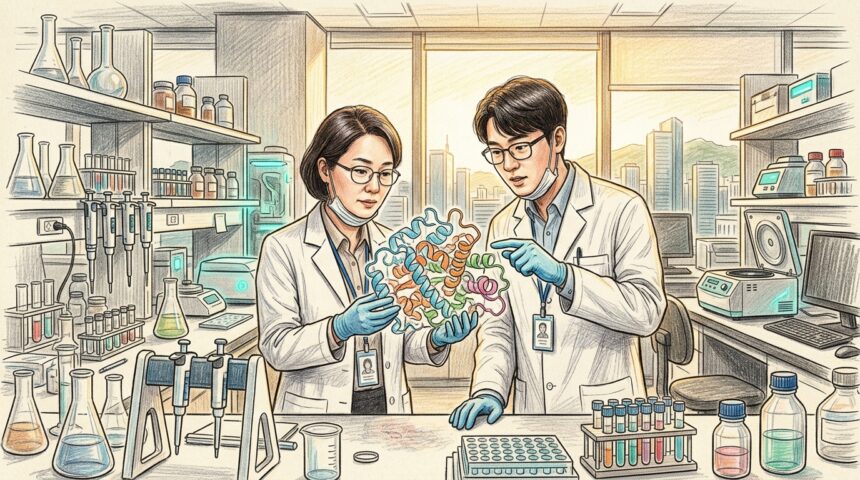
South Korea now has a homegrown answer to AlphaFold 3. KAIST researchers unveiled K-Fold, a model trained to predict protein shapes and the new forms those proteins adopt when drug candidates attach to them. The goal is faster virtual screening of molecule libraries before any wet-lab work begins.

K-Fold emerged from the Ministry of Science and ICT program for AI-specialized foundation models, a government effort to build independent AI capability in biotech and medicine instead of depending on foreign LLMs. Multiple KAIST labs shared the work. Chemistry professor Kim Woo-youn led the project, while AI school professors Hwang Sung-ju and Ahn Sung-soo oversaw model development. Biology professors Oh Byung-ha, Kim Ho-min and Lee Gyu-ri handled protein data and validation.

The faculty startup HITS, spun out of KAIST, built the service that makes K-Fold usable for outside researchers. Early reports put its prediction speed up to 25 times faster than existing models, which could shrink the time needed to scan large candidate-drug libraries for strong binding partners.

The launch fits a broader push by governments to cut reliance on a handful of Western AI labs for core research infrastructure. KAIST positioned the model as a Korean AlphaFold meant to widen the domestic base for AI-driven pharmaceutical and biotech research. Independent benchmarks will settle whether accuracy matches AlphaFold 3, but Korean drug developers now have a homegrown option for structure prediction and virtual screening.


TAGGED:AlphaFold 3drug discoveryFoundation ModelsK-FoldKAISTprotein structure predictionSouth Korea
SOURCES:Seoul Economic Daily
Share This Article
Facebook Copy Link Print
MedSpark Staff
Bymsadmin
Follow:
Medical, Healthcare, & Biotech/Pharma AI News

You Might Also Like

News & Alerts

Altman-backed Merge Labs licenses Butterfly chips to link brains

By
msadmin
September 5, 2026
News & Alerts

Anthropic-backed Ode embeds frontier AI in senior care software

By
msadmin
August 17, 2026
News & Alerts

Probably Genetic nets $10M to shorten rare disease diagnosis

By
msadmin
September 1, 2026
News & Alerts

Google’s AMIE AI Advances from Diagnosis to Long-Term Disease Management in New Nature Study

By
msadmin
June 30, 2026

AI news, analysis, and insights for healthcare, biotech, and pharma.

Facebook Twitter Youtube Linkedin
Quick Links
  • News & Alerts
  • Articles
  • Spotlight
  • Events
About Medspark
  • Mission
  • Services
  • Contact

© Copyright 2026 MedSpark. All rights reserved.

Privacy Policy | Legal