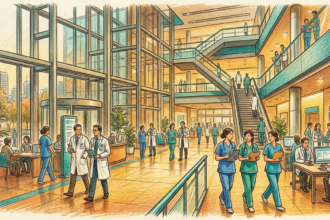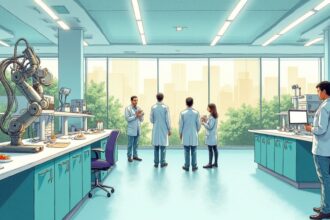

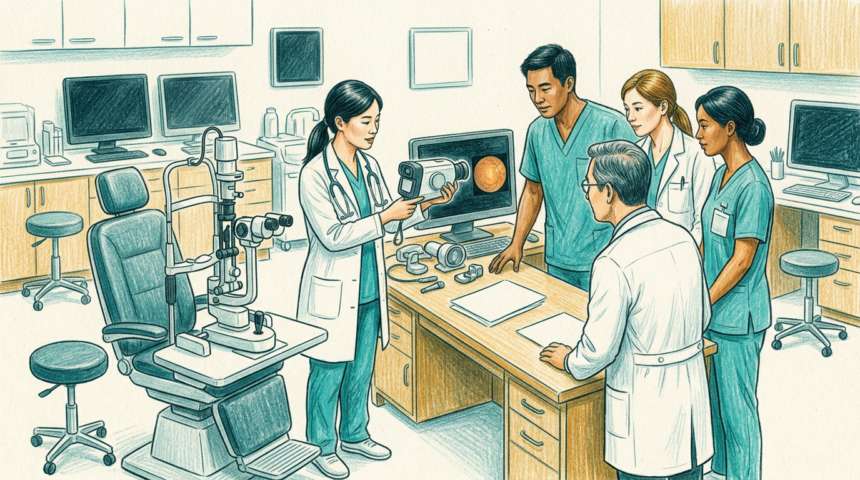
Nature Medicine has published early lessons from a live AI-agent eye clinic in China, run by teams at Tsinghua University and the Beijing Tsinghua Changgung Hospital Eye Center.
The clinic’s AI-TEC agent handled the patient-facing front end of eye care. Its performance climbed when it learned from expert-reviewed, high-quality imaging data, according to the paper.
The headline lesson is not about model accuracy. The authors argue that shifting from AI-assisted tools to AI-native care depends on three things: workflow integration, clinician engagement and measurable clinical value.
Co-authors include Qionghai Dai and Jiamin Wu of Tsinghua’s automation and brain science departments, Ya Xing Wang of the Beijing Visual Science and Translational Eye Research Institute, and Tien Yin Wong of the Singapore Eye Research Institute. Funding came from the National Natural Science Fund of China and a Beijing key laboratory for diagnostic technology in major blinding eye diseases.
Eye care is already one of the most crowded corners of medical AI, with FDA-cleared autonomous screening running in US primary care and pharmacy settings. China’s version pushes further, letting an agent drive intake and triage rather than sit beside a human grader.
That ambition is exactly why the framing matters. Agentic systems change who does which step, so hospitals need redesigned pathways, staff who trust the handoffs, and evidence that outcomes improved. Capability alone does not clear those hurdles.
For health systems weighing agent pilots, the paper reads as a caution against buying on benchmark scores. The measurable-value question has to be answered before scale, not after.