A team at NYU Langone Health has built an AI screener that estimates post-traumatic stress disorder risk by reading what patients say in the emergency department, aiming to catch the condition while care is still within reach.
The system, called PREVIA, published its results in Nature Communications on November 9. In a 145-patient study it reached 95.4 percent sensitivity, flagging every one of 30 patients who went on to develop PTSD a month later.
Why emergency screening breaks down
Only about 28 percent of US emergency departments routinely screen for PTSD, and just two-thirds of those use validated questionnaires, the study reports.
Clinicians have roughly 15 to 20 minutes per patient. A full mental health assessment rarely survives that squeeze, and many trauma patients have lost contact with the hospital by the time symptoms appear.
Three models, one risk score
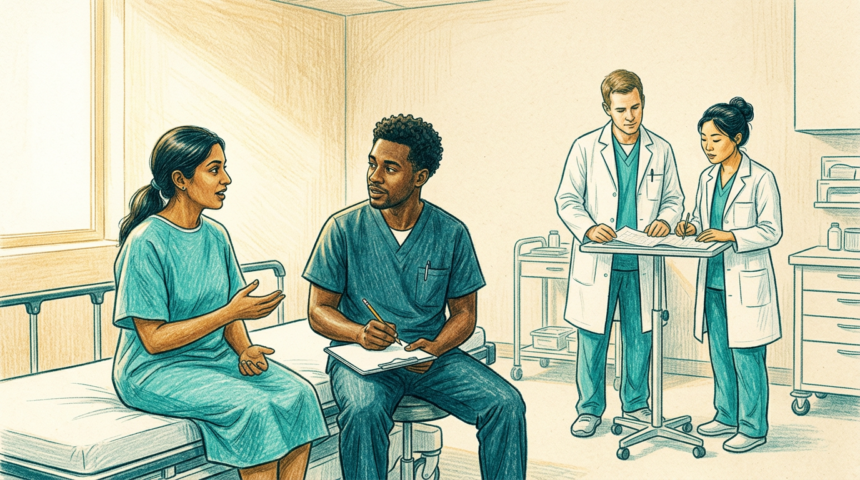
Research coordinators asked patients at two New York City level-1 trauma centers to describe the event that brought them in, recording up to three minutes of video within 24 hours of arrival.
Llama and Mistral scored each transcript independently across eight domains covering symptoms, reactions and protective factors. DeepSeek reconciled the two readings, then a final assessor combined the summary with age, sex, trauma type and PTSD prevalence to yield a 0 to 100 risk score plus an explanation. The pipeline used zero-shot prompts with no fine-tuning on the study sample.
The precision problem
Overall discrimination landed at 78.5 percent AUROC, and precision was 46.8 percent, meaning most flagged patients would not develop PTSD. Sensitivity beat simpler configurations, and subthreshold cases reached 89.7 percent.
Senior author Katharina Schultebraucks, co-director of computational psychiatry at NYU Grossman School of Medicine, said the tool identifies at-risk patients and explains why without adding time to intake.