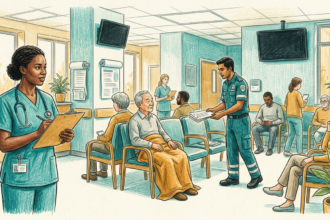

South Korea has released a roadmap for AI-powered care that leans on sensors and software to support older adults around the clock, both at home and in residential facilities. The plan calls for smart diapers and fall-detection sensors that flag health risks to caregivers without requiring a person to be present at all times.
The country faces one of the world’s fastest-aging populations, and the government has been building an AI strategy that treats healthcare and elder care as flagship deployments alongside its semiconductor and software industries.
Sensors where staffing falls short
Smart diapers and floor or wearable fall sensors address a persistent problem in long-term care: staffing ratios that make continuous observation impossible. The devices feed signals into monitoring systems, letting caregivers triage who needs attention first. Similar remote-monitoring programs have spread across Europe and Japan as labor shortages bite.
The roadmap positions AI as an augmentation layer over stretched human workforces rather than a replacement, a framing the government has used to build public acceptance in a country where medical AI regulation has been comparatively permissive.
Asia charts its own AI care path
South Korea joins a broader push across Asia, where governments are drafting healthcare AI strategies that pair domestic technology champions with public care systems. India has outlined its own national approach, and Korea’s export ambitions for medical AI hinge on proving deployments work at population scale at home first.
How the government funds the rollout and whether the sensors clear regulatory review for medical claims will determine whether the roadmap becomes operational policy or remains a statement of intent.