

By using this site, you agree to the Privacy Policy and Terms of Use.
Accept
MedsparkMedsparkMedspark
  • Home
  • News & Alerts
    News & AlertsShow More
    Google’s TabFM Makes Accurate Predictions Without Fine-Tuning Per Dataset
    By
    msadmin
    July 12, 2026
    ARPA-H Awards $160 Million for AI-Enabled Personalized Gene Editing to Tackle Rare Diseases
    By
    msadmin
    July 12, 2026
    Linux Foundation opens health stack with AI commons backed by Google and Microsoft
    By
    msadmin
    July 12, 2026
    Michigan Medicine neuroimaging model outperforms GPT in brain scan analysis
    By
    msadmin
    July 12, 2026
    Machine Learning Links Children’s Screen Time to Distinct Metabolic Fingerprint and Heart Risk
    By
    msadmin
    July 7, 2026
  • Spotlight
    SpotlightShow More
    ARPA-H Awards $160 Million for AI-Enabled Personalized Gene Editing to Tackle Rare Diseases
    By
    msadmin
    July 12, 2026
    Strategic healthcare AI governance framework abstract illustration
    Building a Resilient Healthcare AI Strategy: Insights from Industry Leaders
    By
    msadmin
    May 15, 2026
    Pharma AI Alliance Expands: Owkin and AstraZeneca Deploy New Drug Discovery Models
    By
    msadmin
    May 14, 2026
    7 Must-Attend MedTech Events in South Africa for 2025
    By
    Jostel Owusu
    August 9, 2025
    EY Expert Urges Healthcare Leaders to Double Down on AI Amid Economic Uncertainty
    By
    Yu Chi Huang
    July 11, 2025
  • Articles
    ArticlesShow More
    Google’s TabFM Makes Accurate Predictions Without Fine-Tuning Per Dataset
    By
    msadmin
    July 12, 2026
    A doctor using an AI scribe system with a holographic transcription interface on a tablet in a modern clinic, showing ambient speech recognition and automated clinical documentation
    AI Scribe Adoption in Healthcare, From Ambient Listening to Autonomous Documentation
    By
    msadmin
    July 12, 2026
    A physician using a tablet with a glowing AI assistant hologram nearby, representing cognitive offloading in modern medicine with teal and gold futuristic lighting
    Understanding Cognitive Offloading in Modern Medicine
    By
    msadmin
    July 12, 2026
    AI-powered drug discovery concept showing a holographic molecular structure analyzed by neural networks in a sleek pharmaceutical laboratory with teal and gold lighting
    How Machine Learning Is Reshaping Pharmaceutical R&D
    By
    msadmin
    July 12, 2026
    Michigan Medicine neuroimaging model outperforms GPT in brain scan analysis
    By
    msadmin
    July 12, 2026
  • Events
    EventsShow More
    Stanford Health AI Week Highlights AI’s Growing Role in Medical Education, Patient Empowerment, and Life Sciences
    By
    msadmin
    June 19, 2026
    HIMSS APAC 2026: Re-engineering APAC Health Systems in the AI Era
    By
    msadmin
    June 9, 2026
    AIMed 2026: Bridging the Gap Between AI Promise and Clinical Reality in Kraków
    By
    msadmin
    April 30, 2026
    7 Must-Attend MedTech Events in South Africa for 2025
    By
    Jostel Owusu
    August 9, 2025
    Cleveland Clinic’s First AI Summit Signals Bold Future for Healthcare
    By
    msadmin
    July 19, 2025
  • About
    • Mission
    • Services
    • Contact
Font ResizerAa
MedsparkMedspark
Font ResizerAa
  • Home
  • News & Alerts
  • Spotlight
  • Articles
  • Events
  • About
  • Quick Links
    • Home
    • News & Alerts
    • Spotlight
    • Articles
    • Events
  • About MedSpark
    • Our Purpose & Vision
    • Services
    • Contact
Follow US
News & Alerts

New AI Model Accurately Detects Liver Tumors From Small Datasets, Revolutionizing Cancer Imaging

A team from Science Tokyo has developed a lightweight AI model, MHP-Net, that outperforms leading tumor segmentation systems using just a fraction of the usual training data.

Yu Chi Huang
By
Yu Chi Huang
Yu Chi Huang
ByYu Chi Huang
Yu Chi is a senior regulatory affairs specialist and medical researcher focusing on medical devices.
Published: June 17, 2025
Share
3 Min Read
SHARE

As first reported by EurekAlert!, researchers at the Institute of Science Tokyo (Science Tokyo) have developed a powerful new AI model that segments liver tumors in CT scans with high accuracy—even when trained on extremely limited datasets. Liver cancer remains one of the deadliest and most prevalent cancers globally, and accurate tumor segmentation is a critical, yet labor-intensive, task for radiologists.

Contents
Innovation in small-data AI: Introducing MHP-NetLightweight, fast, and clinically practical

Source: isct.ac.jp.

Traditional AI models demand massive amounts of data to function effectively—often out of reach for many hospitals and research institutions. But this new system, led by Professor Kenji Suzuki and PhD student Yuqiao Yang, promises to make AI-driven cancer detection more accessible.

Innovation in small-data AI: Introducing MHP-Net

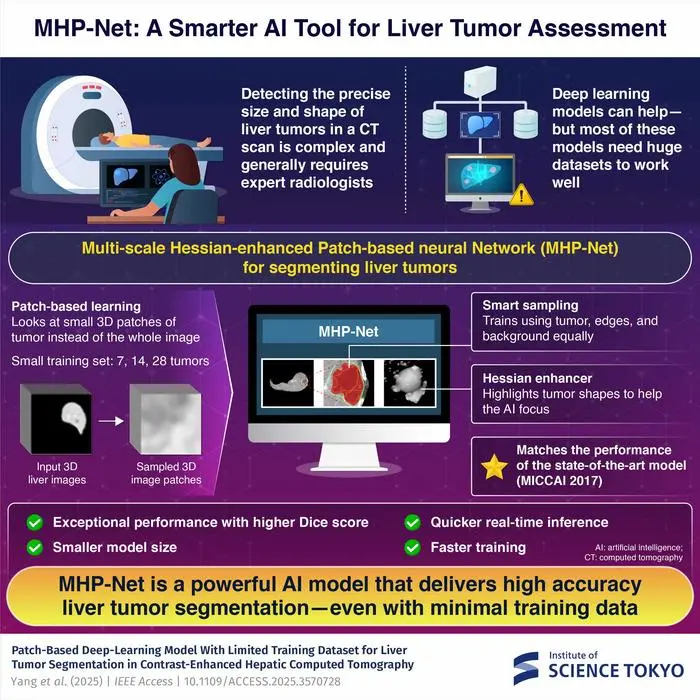
The newly developed architecture, called multi-scale Hessian-enhanced patch-based neural network (MHP-Net), breaks down CT images into small 3D patches and enhances each one with Hessian filtering to highlight spherical features—ideal for spotting tumors. Instead of needing thousands of images, MHP-Net was trained on just 7 to 28 tumor examples and still outperformed industry-standard models like U-Net, Res U-Net, and HDense-U-Net.

This success was measured using the Dice similarity score, a standard for evaluating segmentation accuracy, where MHP-Net achieved impressive results: 0.691, 0.709, and 0.719 with training sets of just 7, 14, and 28 tumors, respectively. These scores indicate a strong alignment between AI predictions and radiologist-labeled ground truths.
Source: bioengineer.org.

Lightweight, fast, and clinically practical

MHP-Net’s architecture is both accurate and practical. The system trains in under 10 minutes and produces results in about 4 seconds per patient, making it well-suited for real-world clinical settings, especially in under-resourced environments with limited computing power. This accessibility opens the door for AI-assisted imaging tools to be implemented in hospitals that lack massive data banks or supercomputing capabilities.

The success of MHP-Net demonstrates the transformative potential of small-data AI in medical imaging. By eliminating the need for extensive datasets, this technology can empower clinics around the world to benefit from advanced diagnostic tools. As the team at Science Tokyo continues to explore its applications in detecting other rare or under-studied conditions, MHP-Net paves the way for scalable, affordable, and accurate AI solutions in global healthcare.


TAGGED:editor-pick
SOURCES:Bioengineer.org
VIA:EurekaAlert!
Share This Article
Facebook Copy Link Print
Yu Chi Huang
ByYu Chi Huang
Yu Chi is a senior regulatory affairs specialist and medical researcher focusing on medical devices.
banner-medspark-horiz

You Might Also Like

News & Alerts

Qure.ai Expands AI Super User Training to U.S., Empowering Radiology Professionals for an AI-Driven Future

By
Yu Chi Huang
June 16, 2025
News & Alerts

Google’s AMIE AI Advances from Diagnosis to Long-Term Disease Management in New Nature Study

By
msadmin
June 30, 2026
Articles

High-Quality Data Is Key to Unlocking AI’s Full Potential in Clinical Trials

By
Yu Chi Huang
June 23, 2025
News & Alerts

Mater Hospital Launches AI Center to Accelerate Heart Attack Diagnosis and Revolutionise Patient Care

By
Yu Chi Huang
June 17, 2025
Facebook Twitter Youtube Linkedin
Quick Links
  • News & Alerts
  • Articles
  • Spotlight
  • Events
About Medspark
  • Mission
  • Services
  • Contact

© Copyright 2026 MedSpark. All rights reserved.

Privacy Policy | Legal