

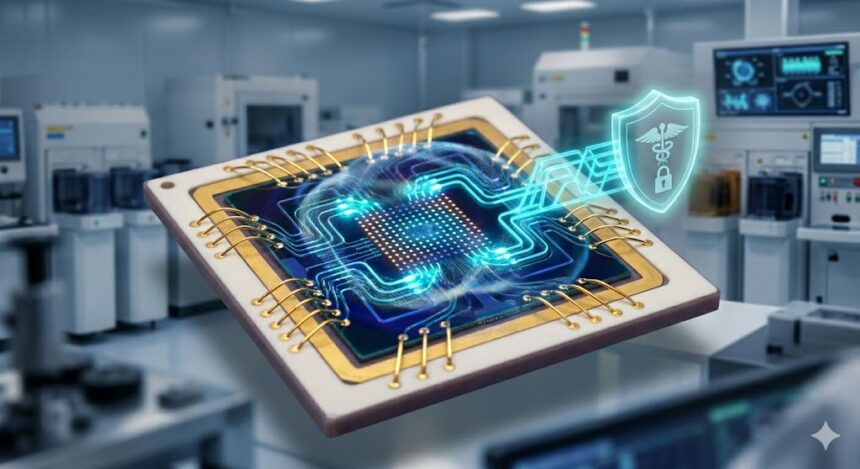
A Manufacturing Milestone for Quantum Computing
Researchers at UNSW Sydney-based startup Diraq, in collaboration with European nanoelectronics institute imec, have demonstrated that silicon-based quantum chips can maintain over 99% fidelity in two-qubit operations even when produced using standard semiconductor fabrication processes. Published in Nature on September 24, 2025, this achievement proves that quantum processors are no longer confined to pristine laboratory conditions. By leveraging existing chipmaking infrastructure, the path to cost-effective, utility-scale quantum computers has become significantly clearer, with implications far beyond academic research.
Implications for Healthcare Data Security and Computation
For healthcare organizations, this breakthrough carries profound significance. Quantum computers capable of solving problems beyond the reach of classical supercomputers could transform drug discovery, genomic analysis, and medical imaging diagnostics. More critically from a security standpoint, the same quantum properties that enable powerful computation also underpin quantum-resistant cryptography. As healthcare systems increasingly store and transmit sensitive patient data (ePHI), the eventual deployment of fault-tolerant quantum processors will demand new encryption standards. Hospital CISOs and health IT directors should monitor this development as a signal to begin planning for post-quantum cryptographic transitions, ensuring that patient data protected today remains secure against future quantum-enabled decryption attempts.
What This Means for Hospital Security Teams
While utility-scale quantum computers remain years away, the demonstrated compatibility with existing semiconductor manufacturing accelerates the timeline. Healthcare compliance officers and medical device security engineers should view this as a driver for updated risk assessments under HIPAA and HITECH frameworks. The same chip fabrication lines producing current processors could soon yield quantum chips, potentially embedding quantum capabilities into medical devices, IoT sensors, and hospital infrastructure sooner than anticipated. Health system CISOs should proactively engage with standards bodies working on quantum-safe protocols and begin inventorying systems that handle long-lived sensitive data, as these will require early migration to quantum-resistant algorithms to maintain patient confidentiality and regulatory compliance.
Source: Sciencedaily