
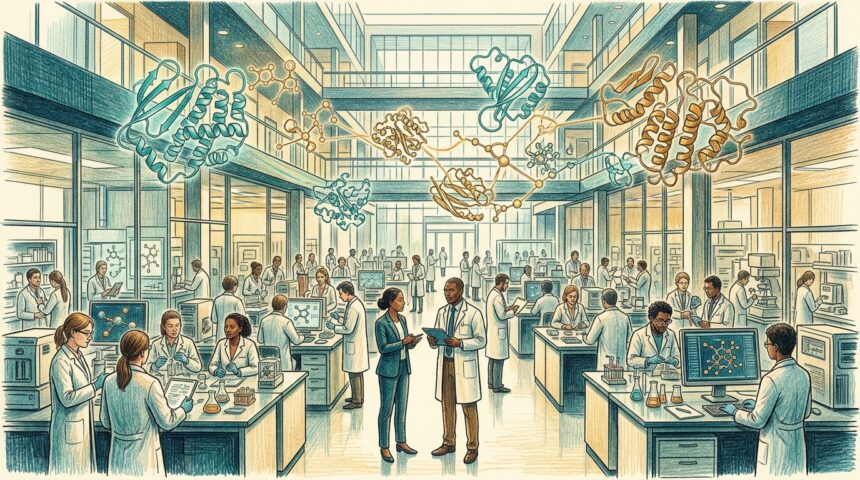
Stanford researcher James Zou has built a “virtual biotech” made of 37,000 collaborating AI agents that designed a cancer drug later confirmed independently by Merck, he said this week at VentureBeat’s Transform conference.
Zou, an associate professor of biomedical data science, said the system mirrors a real pharma company. A chief scientific officer agent oversees divisions for target discovery, molecule design, and safety and clinical trials, with individual agents specializing in genetics, genomics, single-cell data and other domains.
The project grew from a “virtual lab” of five to eight agents that emulated his Stanford lab, complete with an AI professor and AI students holding regular group meetings. That team designed nanobody proteins for recent COVID variants that beat human-designed versions in wet-lab binding tests.
The larger system’s 37,000 clinical trial agents synthesized fragmented trial data and identified single-cell features that predict trial success. Drug targets backed by those features were about 50% more likely to reach the market, Zou said.
The agents then autonomously designed an antibody-drug conjugate targeting the CD276 protein for lung cancer, using only data published before January 2025. Months later, Merck independently developed and validated the same design, which went on to earn FDA breakthrough designation. Zou called it third-party external validation of the agents’ work.
Scaling to thousands of agents required new infrastructure. His team built Paperclip, an open-source platform that maps scientific databases into an AI-native virtual file system, cutting time and cost by more than an order of magnitude versus agents without it.
Zou argued that multi-agent teams that debate and disagree produce more robust reasoning than a single model, and that leaders should optimize environments rather than fixed workflows.