
Transforming Research Efficiency with Generative AI
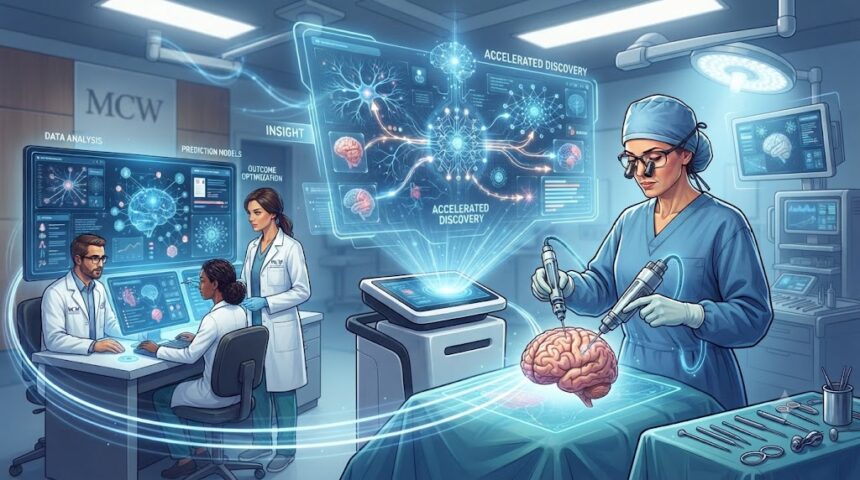
At the Medical College of Wisconsin (MCW), Dr. Anai Kothari, assistant professor of surgical oncology and inaugural director of the Bud and Sue Selig Hub for Surgical Data Science, is leveraging large language models (LLMs) to accelerate medical research. These AI tools process massive datasets far more efficiently than traditional methods, moving research from hypothesis to clinical application at unprecedented speed.
Dr. Kothari highlights a striking example: a research fellow who spent 12 months building a model to predict surgery duration—testing 40 different model types with extensive human effort—was able to reproduce the same project in about a week using generative AI tools like ChatGPT. This leap in efficiency has the potential to transform surgical planning, patient outcomes, and resource allocation in hospitals.
From Narrow Models to Broad AI Capabilities
Before the release of ChatGPT in December 2022, most AI applications in healthcare were narrow, response-based models limited to specific tasks. The generative AI era has shifted this paradigm, enabling researchers to tackle complex, data-intensive problems with greater agility. However, Dr. Kothari emphasizes that speed must not come at the expense of accuracy or safety.
The Critical Role of Human Oversight
Despite AI’s power, Dr. Kothari insists that medical expert oversight remains essential. “We still need to keep that human in the loop, assessing and evaluating the outputs for bias, things that might be misleading, or could actually cause harm if not carefully checked,” he says. His role at MCW includes developing governance policies for AI usage, ensuring patient privacy and data integrity are protected as research accelerates.
AI’s Impact on Healthcare Jobs
Dr. Kothari does not foresee AI replacing pathologists or radiologists, as expert oversight remains indispensable for clinical decision-making. However, he acknowledges that administrative roles like medical scribes are likely to be phased out, replaced by AI-powered note-taking tools that can streamline documentation while maintaining accuracy.
Building AI Literacy for Providers and Patients
As AI becomes more integrated into healthcare, Dr. Kothari stresses the importance of strong AI literacy for both clinicians and patients. “My biggest caution is just talking about this at a depth that makes people understand what’s out there, what’s coming, and feel educated about this wave of new technology,” he says. Educating stakeholders will be key to ensuring AI is used effectively and ethically in medical settings.
Looking Ahead: Collaborative Development of Clinical AI
Dr. Kothari calls for collaboration between medical experts, companies, and research labs to develop the best versions of AI for clinical environments. “We need to have experts that understand medical context, working together to think about how we can get the best version of artificial intelligence into our clinical environments,” he explains. This collaborative approach will help ensure that AI tools are safe, effective, and aligned with patient needs across Wisconsin and beyond.