
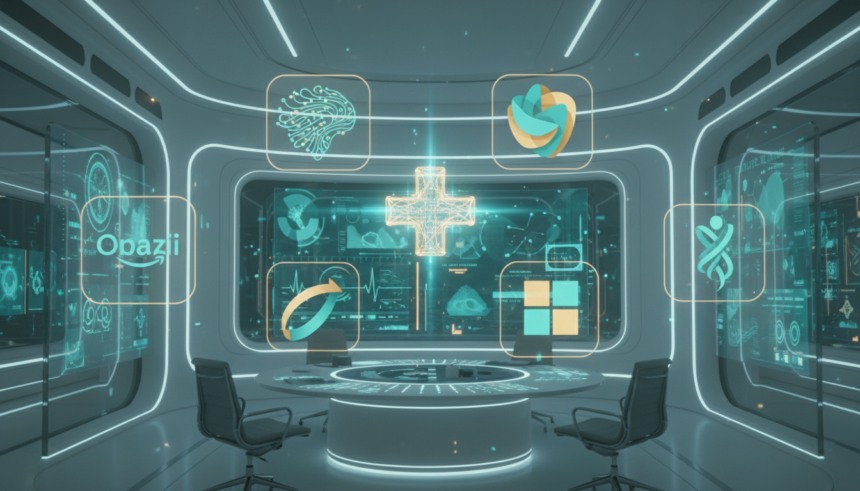
Five of the world’s largest technology companies have launched dedicated consumer-facing AI health assistants in 2026, marking a structural shift in how people access medical guidance, according to a new analysis in the Journal of Medical Internet Research.
OpenAI’s ChatGPT Health, Google’s Verily Me, Amazon Health AI, Microsoft Copilot Health, and Anthropic’s Claude for Healthcare now allow users to upload medical records, sync wearable data, and interpret lab results in real time. The shift from enterprise-focused AI to direct-to-consumer health platforms is now complete, the JMIR report concludes.
Each company takes a different approach. ChatGPT Health leverages its massive user base and offers personalized health workspaces for free. Verily Me uses a hybrid model where licensed providers review AI-generated insights. Amazon links AI triage directly to its One Medical clinics and pharmacy. Copilot Health integrates citations from Harvard Health and helps users find clinicians by insurance. Claude for Healthcare markets a safety-first approach using constitutional AI principles.
But accuracy concerns persist. KFF’s March 2026 tracking poll found that 32% of U.S. adults have used AI for health information, and 40% of those have uploaded personal medical data. Yet a Nature Medicine study found that ChatGPT Health under-triaged more than half of medical emergencies in clinical testing, potentially directing patients toward routine follow-up instead of emergency care.
A separate study showed that earlier AI chatbots performed no better than standard web searches in helping patients identify conditions and choose appropriate care. Researchers also observed inconsistent advice for identical symptoms depending on how questions were phrased.
Privacy is another open question. While Amazon and Verily market HIPAA compliance, ChatGPT Health and Claude operate in encrypted but not officially HIPAA-covered environments. As more patients turn to AI for first-line health advice, the gap between convenience and clinical reliability remains the industry’s biggest unsolved challenge.