
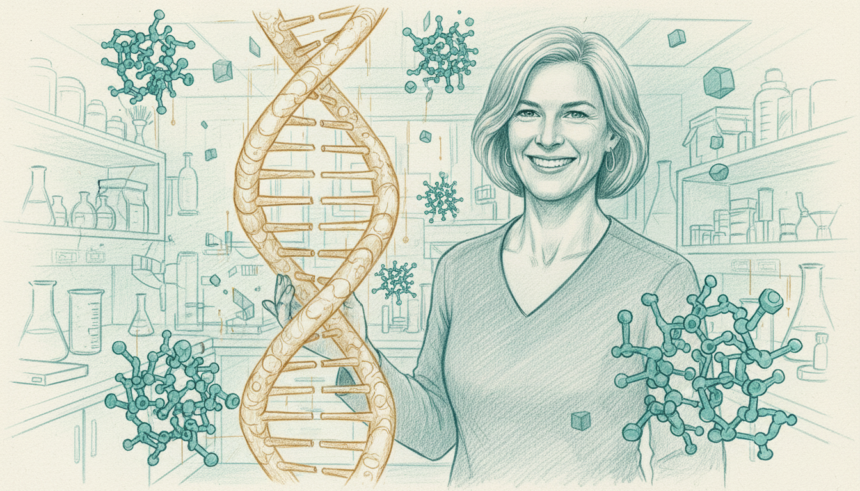
Jennifer Doudna, the Nobel laureate who co-invented CRISPR, is entering the AI protein design field. Her lab at UC Berkeley published a paper in Science on July 16 describing a platform that uses artificial intelligence to generate novel gene-editing enzymes from scratch.
The team used Meta’s inverse protein folding model, which works opposite to DeepMind’s AlphaFold. Instead of predicting shape from sequence, it starts from a target protein backbone and generates amino acid sequences likely to fold into it. By feeding the model a TnpB nuclease backbone and restricting output to include known DNA-binding sites, the researchers generated thousands of potential new enzymes.
Lead scientist Petr Skopintsev began with Meta’s AI model and found the TnpB results promising. Fellow researcher Isabel Esain-Garcia validated candidate enzymes in human, plant, and bacterial cells. One designed protein successfully bound and cut DNA with no natural equivalent.
The work marks Doudna’s first published use of AI to design new proteins, a field previously dominated by fellow Nobel laureate David Baker. Doudna’s lab collaborates closely with Baker’s. “Hopefully it’s more of a ‘1 + 1 = 3’ situation where we can use our complementary strengths to make some new breakthroughs,” she told Fierce Biotech.
The approach enables on-demand enzyme design for treating genetic diseases or engineering climate-resilient crops, vastly expanding what evolution alone provides.