
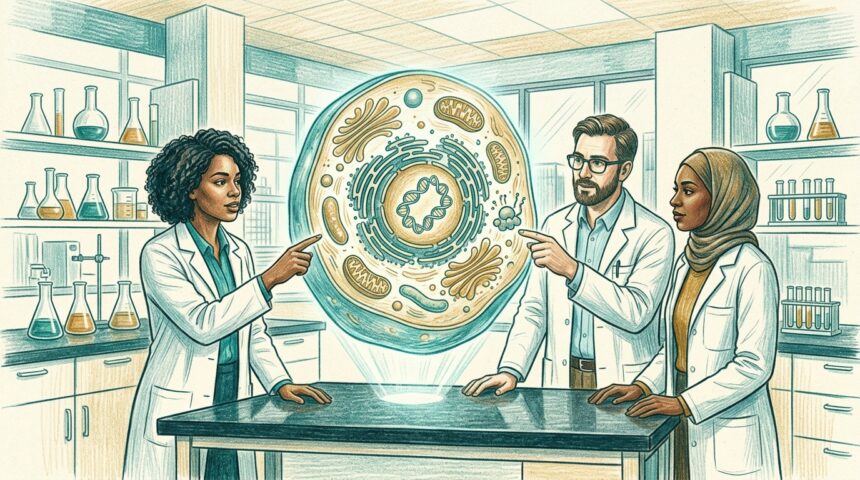
David Baker’s GenBio AI has released AIDO Cell, a virtual cell system that models how an entire human cell behaves. Baker co-founded the Palo Alto startup and shared the 2024 Nobel Prize in chemistry.
Baker frames the ambition with a Google Earth analogy. AlphaFold predicts the structure of one protein, the way a street view shows one building. AIDO Cell tries to predict how the whole city works, with DNA, RNA, proteins and cellular behavior linked in a single computational environment.
The system is stateful, meaning the simulated cell remembers the consequences of earlier interventions. Instead of every experiment starting from an untouched baseline, a sequence of perturbations accumulates. That matters for aging research, where history-dependent biology is central. Version 1.0 supports K562 leukemia and HepG2 liver cancer cell lines, with more cell types in development.
An accompanying environment, AIDO Lab, lets researchers inspect a coherent multiomic profile of a virtual cell, including predicted protein staining. The rollout follows a Nature Medicine perspective from GenBio researchers calling for connected AI models across biological scales.
During simulations, AIDO Cell can report predicted biological age and show how it shifts under intervention. Researchers caution that a younger predicted age is not proof of rejuvenation, and that computational changes still need confirmation in wet biology.