
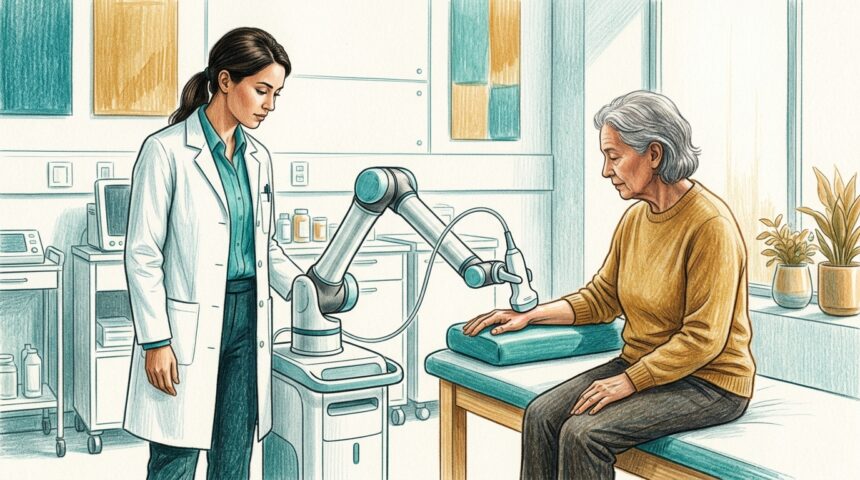
ROPCA, a Danish medtech firm, has secured FDA 510(k) clearance for two products. One is Arthur, an autonomous robot that uses AI to scan joints. The other is Diana, software that interprets the resulting images. The green light opens the US market for the firm’s musculoskeletal imaging workflow.
Arthur scans finger, hand and wrist joints automatically, capturing ultrasound images with no sonographer at the probe. A clinician still supervises the session. Diana analyzes the images and supports automated report generation. Together they form an end-to-end pipeline that keeps clinical decisions with human clinicians.
The robot has been CE-marked since 2022 and has completed more than 5,400 scans covering 83,500 joints across six European countries. ROPCA plans to build clinical and commercial partnerships in the US, where rheumatology capacity is stretched: the American College of Rheumatology estimates 72% of US counties have no rheumatologist, with workforce projections pointing to a wider gap by 2030.
CEO Johannes Schaeferhoff called the clearance a defining moment for the company and a new model for scalable musculoskeletal diagnostics. Standardized, reproducible joint imaging could help expand access to objective imaging for patients with inflammatory arthritis.
The clearance is the latest sign that autonomous imaging robots are moving into clinical workflow, following recent FDA green lights for automated blood draw and prostate ultrasound systems.