
GE HealthCare pulled the covers off Allia Celeo at the Transcatheter Cardiovascular Therapeutics meeting in San Diego on November 1, adding a ceiling-mounted member to its Allia interventional line. The system is aimed at catheterization labs and interventional radiology suites that run high patient volumes across mixed cases.
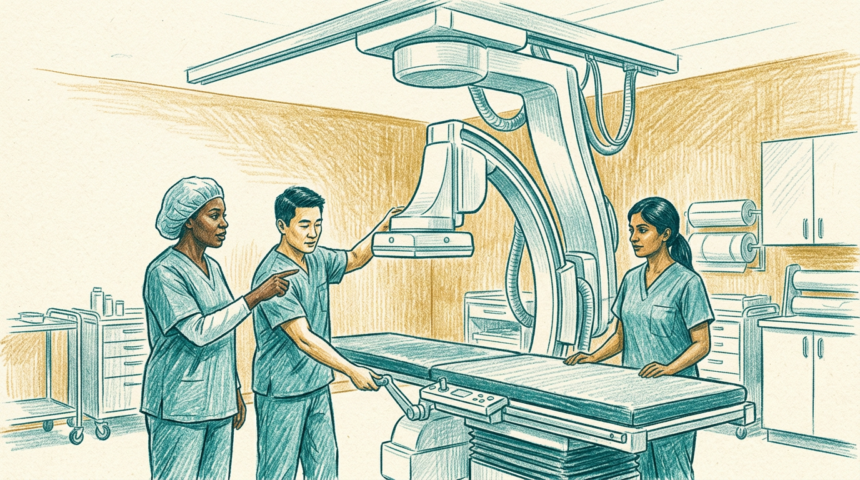
The design choice that matters is where the hardware lives. By hanging the gantry from an integrated ceiling rail instead of a floor pedestal, GE frees the floor around the table for staff and carts. The company says cables are routed inside the rail rather than trailing across the room.
Wider bore, steeper angles
Allia Celeo pairs an extra-wide bore with a slim C-arm and a thin detector lift. GE says that combination lets the arm reach steep angulations even in patients with a high body mass index, while keeping the sight line between team members clear.
The imaging chain is marketed as AI-enabled. In practice it automatically adjusts acquisition settings to hold image quality steady while pushing radiation dose as low as possible, across both 2D and 3D modes.
A digital twin on the screen
Clinicians can preview gantry positioning before committing to a move. Controls are duplicated at several points around the suite, so the person nearest the patient can adjust table and arm positions without walking back to a console.
GE also bundled OnWatch Predict, a deep learning service that watches system health and flags maintenance needs before a case gets cancelled.
Price and regulatory status were not disclosed. Jyoti Gera, who leads GE HealthCare’s cardiovascular and interventional solutions business, framed the launch around room rhythm rather than raw specs. The claim to watch is whether a ceiling-mounted arm shortens room turnover time enough to justify the retrofit.