

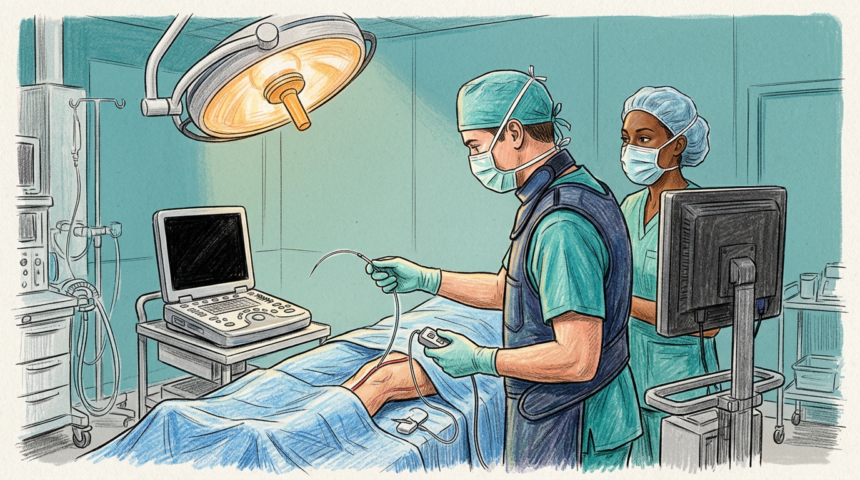
Evident Vascular now holds 510(k) clearance in the US for its Guidance System and Evident peripheral imaging catheters, a peripheral IVUS platform whose imaging pipeline was designed around AI rather than retrofitted with it.
The indication covers ultrasound review of intravascular pathology while peripheral vascular interventions are underway, meaning work in limb arteries rather than coronary cases. Clearance K261648 landed October 28 and was made public on November 4.
Peripheral IVUS has deep outcome support yet remains underused. The hardware is awkward to run, reading the images takes practice, and each case gains setup minutes. Evident targets all three friction points at once.
Catheters ship flushless and plug and play, so the saline preparation step disappears. Voice control needs no hands, leaving the operator free during the case. On imaging, the design combines wide frequency bandwidth, a reworked transducer, and dynamic frequency control, which the company says keeps vessel borders legible across differing vessel sizes and depths.
Custom electronics handle real-time processing on NVIDIA accelerated computing, and the firm belongs to the NVIDIA Inception program. A dedicated workstation is meant to put models at the bedside, though decision support sits in later submissions rather than this clearance.
Eric Secemsky, who directs vascular intervention at Beth Israel Deaconess Medical Center, described vessel-edge definition and field-of-view consistency as remarkable for sizing vessels and gauging results.
Howard Rosen, chief executive, says engineers built the whole imaging chain, not just software riding on existing hardware. Vensana Capital’s Justin Klein, a founder and board member, calls the clearance a base for further filings aimed at precision therapy guidance.
Sales in the US must wait while integration and verification conclude. Hospitals shopping for peripheral IVUS should note that a cleared option with AI built in has arrived at an awkward moment for incumbents.