Walking carries more diagnostic signal than most clinical visits capture, and a new study suggests a single camera can read it.
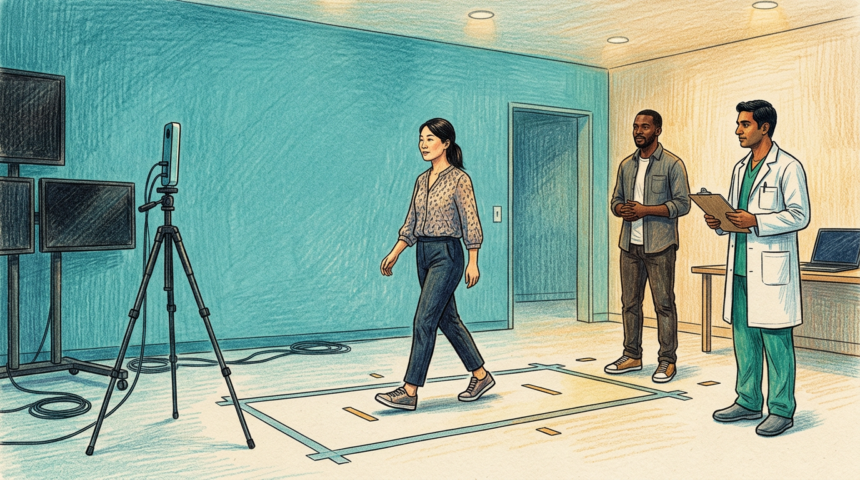
Researchers writing in Nature Medicine trained a foundation model on three-dimensional skeletal motion from 3,328 deeply phenotyped adults in the Human Phenotype Project. Participants were filmed by one depth camera across five motor tasks, then the resulting sequences were fed through self-supervised learning to produce gait embeddings.
Those embeddings beat hand-engineered gait features at predicting endpoints spanning 18 physiological systems. Age came out at a Pearson correlation of 0.69, with body composition, cardiovascular measures and mental health scores also tracked. The learned representations added predictive value on top of standard clinical baselines for 24 binary outcomes.
The finding rests on a simple framing: gait is a systemic biosignal, not a symptom of one disease. Prior gait AI has mostly been built to grade Parkinson’s or post-stroke impairment, one condition at a time.
The practical appeal is logistics. A depth camera and five short tasks need no wearables, no technician training and no lab visit. The authors argue that makes gait a cheap vital sign, closer to blood pressure than to a motion-capture suite.
Caveats apply. The cohort is deeply phenotyped, meaning unusually rich lab and imaging data accompanies each walk, and the preprint drew 3,414 adults before peer review trimmed the set. Whether embeddings hold across cameras, footwear and clinical populations is the next test.