Drug developers keep losing candidates to models that behave nothing like a living body, and Vitroscope just raised money to keep human tissue alive long enough to argue back.
Two checks from the Research Council of Norway brought $2 million, non-dilutive, and they sit alongside a seed round of $5 million co-led by Cerberus Ventures and YZR Capital. Arcas Ventures, Golden Egg Check, Devico Invest and a group of angels joined that round. Total raised now stands at $8.8 million.
What the bench system does
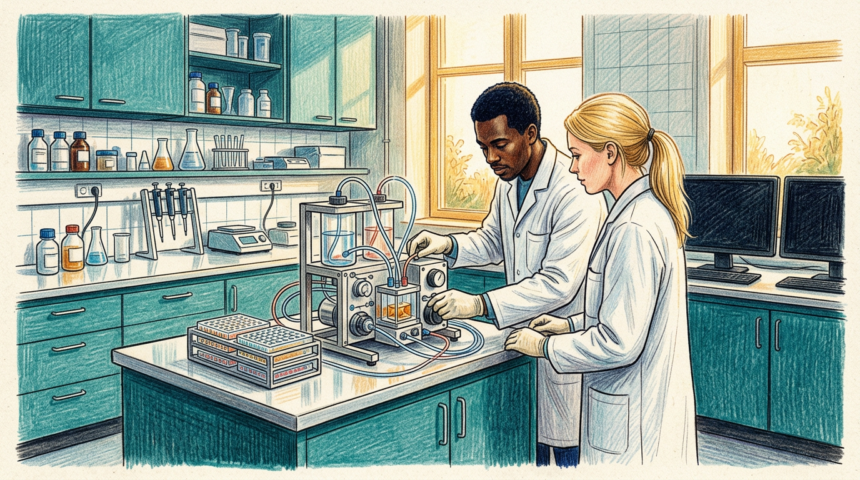
Its vitro.alive system pushes programmable fluid through living tissue and organoids while imaging the sample and logging oxygen, pH and temperature. Researchers track how a treatment reshapes the tissue across days, not at one fixed timepoint.
“Living tissue cannot be reduced to a snapshot,” said chief executive and cofounder Carlo Kriesi. Static slices, the company argues, miss the physiology that decides whether a drug works.
Where the money goes
Commercial rollout of vitro.alive comes first, then development of vitro.scale, a higher-throughput version built for 96 parallel experiments. Tests with customers begin in 2027, and the company plans to launch the system in 2028.
The lane is crowded. Apoha raised $36 million in June for a liquid-state measurement platform, Vivodyne launched with $38 million to grow and dose more than 10,000 tissues robotically, and Isomorphic Labs went the modeling route with a $2.1 billion Series B for AI-driven design.
What separates them is where the evidence comes from: simulated, grown or kept alive. Vitroscope is betting that human-relevant physiology, continuously monitored, is still the data AI drug discovery cannot manufacture.