

By using this site, you agree to the Privacy Policy and Terms of Use.
Accept
MedsparkMedsparkMedspark
  • Home
  • News & Alerts
    News & AlertsShow More
    AI takes center stage in 2026 Prix Galien USA nominee list
    By
    msadmin
    August 26, 2026
    Open-ended AI diagnosis lags multiple choice in brain scans
    By
    msadmin
    August 26, 2026
    Healthcare LLM code leaks API keys at a rising rate
    By
    msadmin
    August 26, 2026
    Suki unbundles voice notes for Epic and MEDITECH hospitals
    By
    msadmin
    August 26, 2026
    AI physio firm Sword Health to buy mental health app Headspace
    By
    msadmin
    August 26, 2026
  • Spotlight
    SpotlightShow More
    Robinhood Ventures Fund II brings retail capital to healthcare AI
    By
    msadmin
    August 13, 2026
    Adialante brings accessible MRI-based cancer screening
    By
    msadmin
    August 11, 2026
    CellType models biology so AI can discover drugs
    By
    msadmin
    August 11, 2026
    Healthcare AI startups in Robinhood Ventures Fund II
    By
    msadmin
    August 11, 2026
    OpenAI launches GPT-Rosalind for life sciences research
    By
    msadmin
    July 17, 2026
  • Articles
    ArticlesShow More
    Consumer chatbots are building a medical system outside hospitals
    By
    msadmin
    August 21, 2026
    Reasoning gaps hold back AI agents in scientific discovery
    By
    msadmin
    August 11, 2026
    Benchmark scores can’t track real clinical LLM use, Stanford says
    By
    msadmin
    August 11, 2026
    Teladoc puts 100 percent of fees at risk with new AI-powered platform
    By
    msadmin
    July 27, 2026
    Johns Hopkins finds frontier AI agents fail most complex health tasks
    By
    msadmin
    July 27, 2026
  • About
    • Mission
    • Services
    • Contact
  • Shop
    • All Items
    • By Category
    • Cart
  • Newsletter
Font ResizerAa
MedsparkMedspark
Font ResizerAa
  • Home
  • News & Alerts
  • Spotlight
  • Articles
  • About
  • Shop
  • Newsletter
  • Home
  • News & Alerts
  • Spotlight
  • Articles
  • About
    • Mission
    • Services
    • Contact
  • Shop
    • All Items
    • By Category
    • Cart
  • Newsletter
Follow US
Articles

HKUST Pioneers Micro-Robotics and AI Tools to Reshape Global Healthcare

From ultra-miniature surgical robots to gamified respiratory monitors, HKUST is redefining medical technology with innovations that blend precision, interactivity, and AI.

Yu Chi Huang
By
Yu Chi Huang
Yu Chi Huang
ByYu Chi Huang
Yu Chi is a senior regulatory affairs specialist and medical researcher focusing on medical devices.
Published: July 2, 2025
Share
3 Min Read
SHARE

As first reported by OpenGov Asia, healthcare systems worldwide are struggling to keep pace with the demands of ageing populations and rising chronic illness. In response, researchers at the Hong Kong University of Science and Technology (HKUST) are advancing a new wave of medical technologies that combine robotics and artificial intelligence (AI). Their latest breakthroughs span surgical precision, rehabilitation assessment, and home-based respiratory monitoring — all designed to improve patient care while supporting clinicians.

Contents
Ultra-small surgical robot expands access and precisionAI-driven tools for rehabilitation and respiratory careHuman-centric design meets future-forward healthcare

Source: innovationhub.hk.

Ultra-small surgical robot expands access and precision

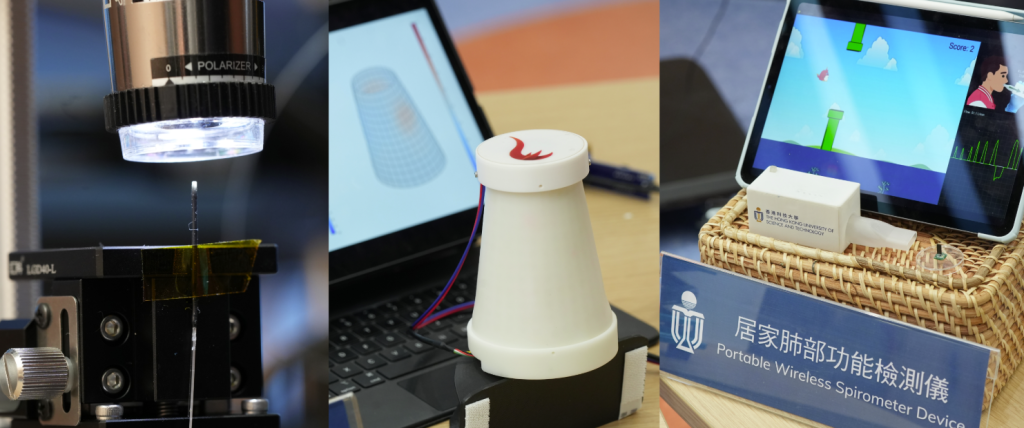
One of HKUST’s standout innovations is an ultra-miniaturised surgical robot with a diameter of just 0.95 millimetres—small enough to navigate tight, delicate spaces in the human body like bronchial or fallopian tubes. Despite its size, the robot is a fully capable surgical assistant, integrating imaging, navigation, drug delivery, and thermal therapy capabilities. Its compact form factor not only reduces invasiveness but opens new possibilities for minimally invasive procedures in previously unreachable anatomical areas.

AI-driven tools for rehabilitation and respiratory care

HKUST’s second innovation, PhyTac, is a cone-shaped handgrip embedded with 368 sensors that mirrors the spiral pattern of Aloe polyphylla. Designed to track motor recovery in patients, especially those undergoing stroke or neurological rehabilitation, the device uses AI to detect subtle changes in grip strength and force distribution, allowing clinicians to assess recovery in real time with greater accuracy than traditional methods.
Source: hkust.edu.hk.

The third device addresses a post-pandemic focus on respiratory health: a portable, 78-gram wireless spirometer that combines clinical utility with user engagement. The system’s gamified interface—in which users control a virtual bird by breathing—encourages regular use while collecting data for remote monitoring by healthcare providers. This not only enhances compliance but also makes routine testing more engaging and accessible.

Human-centric design meets future-forward healthcare

These devices underscore HKUST’s commitment to developing intelligent tools that merge technical excellence with practical usability. By focusing on miniaturisation, AI-powered sensing, and user-friendly interfaces, the researchers are creating medical technologies that fit seamlessly into both clinical environments and patients’ daily lives.

HKUST’s innovations represent a broader shift in healthcare towards collaboration between humans and intelligent machines. By enhancing the precision, awareness, and accessibility of medical devices, their work not only meets urgent global health needs but also sets a precedent for how robotics and AI can humanise, rather than replace, modern medicine.

TAGGED:editor-pick
VIA:OpenGov Asia
Share This Article
Facebook Copy Link Print
Yu Chi Huang
ByYu Chi Huang
Yu Chi is a senior regulatory affairs specialist and medical researcher focusing on medical devices.

You Might Also Like

Articles

Hospital CEOs must own AI safety, not delegate it to IT

By
msadmin
July 22, 2026
Articles

Why Medical Schools Must Teach Critical Thinking Before AI Tools

By
msadmin
May 28, 2026
Articles

AI Partnerships and Imaging Advances Reshape Clinical Workflows in Health Systems

By
msadmin
June 17, 2026
AI-powered drug discovery concept showing a holographic molecular structure analyzed by neural networks in a sleek pharmaceutical laboratory with teal and gold lighting
Articles

How Machine Learning Is Reshaping Pharmaceutical R&D

By
msadmin
July 12, 2026

AI news, analysis, and insights for healthcare, biotech, and pharma.

Facebook Twitter Youtube Linkedin
Quick Links
  • News & Alerts
  • Articles
  • Spotlight
  • Events
About Medspark
  • Mission
  • Services
  • Contact

© Copyright 2026 MedSpark. All rights reserved.

Privacy Policy | Legal