

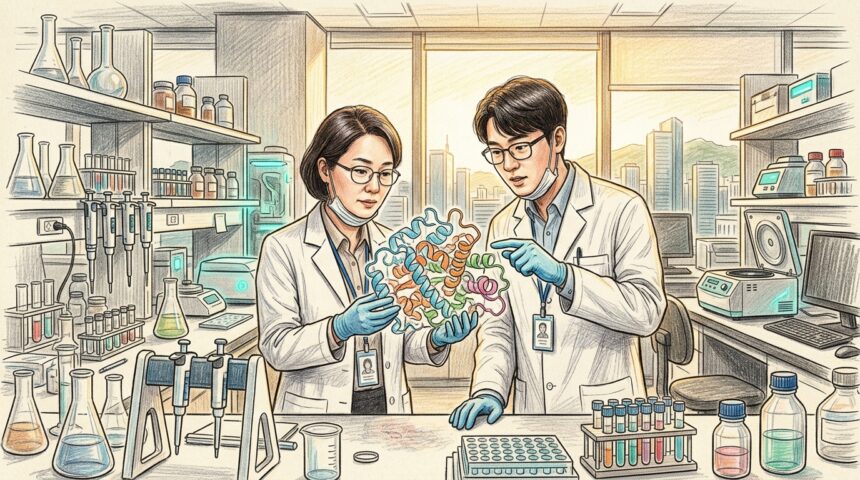
South Korea now has a homegrown answer to AlphaFold 3. KAIST researchers unveiled K-Fold, a model trained to predict protein shapes and the new forms those proteins adopt when drug candidates attach to them. The goal is faster virtual screening of molecule libraries before any wet-lab work begins.
K-Fold emerged from the Ministry of Science and ICT program for AI-specialized foundation models, a government effort to build independent AI capability in biotech and medicine instead of depending on foreign LLMs. Multiple KAIST labs shared the work. Chemistry professor Kim Woo-youn led the project, while AI school professors Hwang Sung-ju and Ahn Sung-soo oversaw model development. Biology professors Oh Byung-ha, Kim Ho-min and Lee Gyu-ri handled protein data and validation.
The faculty startup HITS, spun out of KAIST, built the service that makes K-Fold usable for outside researchers. Early reports put its prediction speed up to 25 times faster than existing models, which could shrink the time needed to scan large candidate-drug libraries for strong binding partners.
The launch fits a broader push by governments to cut reliance on a handful of Western AI labs for core research infrastructure. KAIST positioned the model as a Korean AlphaFold meant to widen the domestic base for AI-driven pharmaceutical and biotech research. Independent benchmarks will settle whether accuracy matches AlphaFold 3, but Korean drug developers now have a homegrown option for structure prediction and virtual screening.