
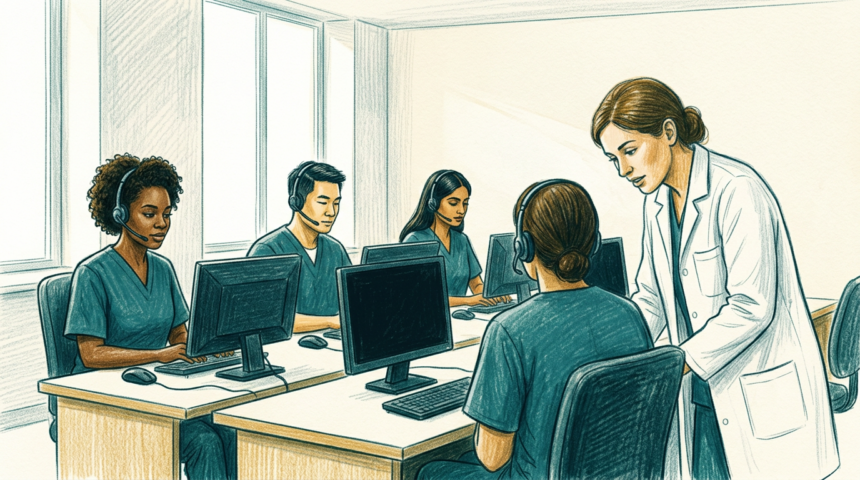
Every month, roughly 400,000 interactions land with St. Luke’s Hospital in Kansas City, Missouri. They cover prescription requests, appointment scheduling and clinical consultations.
At an average handle time of 15 minutes, that volume worked out to about 100,000 labor hours monthly. Direct labor costs topped $3.5 million a month, or close to $43 million a year, with agents and triage nurses pulled into eligibility checks, routing and documentation.
For the build, the hospital turned to NextGen Coding, which proposed an agentic AI call center. Each incoming call gets transcribed and its intent classified, then routed to software or to a person under preset escalation rules. Before any handoff, automated intake collects symptoms and history, a step NextGen expects to shave roughly a minute and a half off calls that still need a human.
NextGen’s steady-state projections cut human-handled volume to about 120,000 a month. Staffing would fall from 781 people to 211, and monthly workforce spending from $3.57 million to roughly $965,000. Subtract the AI infrastructure bill and the hospital still comes out roughly $28 million ahead each year.
Rollout is staged, starting with conservative automation thresholds before scheduling and prescription workflows are added.