

By using this site, you agree to the Privacy Policy and Terms of Use.
Accept
MedsparkMedsparkMedspark
  • Home
  • News & Alerts
    News & AlertsShow More
    California law keeps a clinician’s judgment above the algorithm
    By
    msadmin
    October 2, 2026
    Talus skips protein folding to screen 3.4 billion compounds
    By
    msadmin
    October 2, 2026
    Cradle signs a drug discovery deal with Hansa Biopharma
    By
    msadmin
    October 2, 2026
    Sepsis research gets $38M to model each ICU patient
    By
    msadmin
    October 2, 2026
    Weizmann model rebuilds viewed images from brain scans
    By
    msadmin
    October 2, 2026
  • Spotlight
    SpotlightShow More
    Robinhood Ventures Fund II brings retail capital to healthcare AI
    By
    msadmin
    August 13, 2026
    Adialante brings accessible MRI-based cancer screening
    By
    msadmin
    August 11, 2026
    CellType models biology so AI can discover drugs
    By
    msadmin
    August 11, 2026
    Healthcare AI startups in Robinhood Ventures Fund II
    By
    msadmin
    August 11, 2026
    OpenAI launches GPT-Rosalind for life sciences research
    By
    msadmin
    July 17, 2026
  • Articles
    ArticlesShow More
    Proteomics model picks breast cancer drugs from biopsies
    By
    msadmin
    September 10, 2026
    CRISP model reads frozen sections to steer cancer surgery
    By
    msadmin
    September 10, 2026
    Consumer chatbots are building a medical system outside hospitals
    By
    msadmin
    August 21, 2026
    Reasoning gaps hold back AI agents in scientific discovery
    By
    msadmin
    August 11, 2026
    Benchmark scores can’t track real clinical LLM use, Stanford says
    By
    msadmin
    August 11, 2026
  • About
    • Mission
    • Services
    • Contact
  • Shop
    • All Items
    • By Category
    • Cart
  • Newsletter
Font ResizerAa
MedsparkMedspark
Font ResizerAa
  • Home
  • News & Alerts
  • Spotlight
  • Articles
  • About
  • Shop
  • Newsletter
  • Home
  • News & Alerts
  • Spotlight
  • Articles
  • About
    • Mission
    • Services
    • Contact
  • Shop
    • All Items
    • By Category
    • Cart
  • Newsletter
Follow US
News & Alerts

AKASA lets AI code inpatient charts without a human coder

The revenue-cycle vendor says its new platform codes complex hospital stays end to end, with health systems setting the limits.

MedSpark Staff
By
msadmin
MedSpark Staff
Bymsadmin
Medical, Healthcare, & Biotech/Pharma AI News
Follow:
Published: October 2, 2026
Share
2 Min Read
SHARE

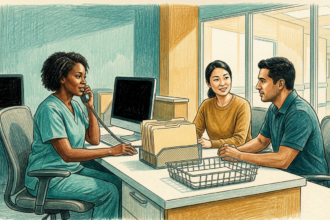
AKASA has moved deeper into the hospital revenue cycle, launching an autonomous platform for inpatient medical coding and clinical documentation integrity on October 2. The South San Francisco vendor is expanding beyond its AI-assisted prebill review roots.

Coding a patient record drives reimbursement and quality reporting, and AKASA says the work is still mostly manual and error-prone. Its case rests partly on a peer-reviewed 2025 study in npj Health Systems, which recorded coding error rates reaching 20 percent. A Government Accountability Office review from July 2026 drew a related conclusion, naming verifiable accuracy as the hard part for hospitals putting AI to work on notes and coding.

Rather than one general model, AKASA tailors its AI per health system – adjusting for patient mix, clinical criteria and documentation conventions. Health systems keep the controls: they set the audit sampling rate, pick which service lines and payer mixes are in scope, and cap what the system may code. The platform carries ICD-10-CM and ICD-10-PCS natively.

The system ingests whole charts – discharge summaries, operative notes, progress notes, consults, labs, imaging and medications. It then runs a case from start to finish and assigns a complete code set for every specialty. Each code is cited to the precise chart language that supports it, plus the reasoning and a confidence score. AKASA says that trail lets a reviewer validate output in seconds.

A coder needs 30 to 60 minutes per inpatient encounter, and staffing shortages can leave charts untouched for days after discharge. AKASA claims its system finishes in under 90 seconds. In blinded third-party evaluations, its AI matched or beat human experts on MS-DRG assignment, principal diagnosis, clinical quality capture and present-on-admission accuracy, AKASA says. Cleveland Clinic, already a prebill customer, has said it will explore the autonomous tools.

TAGGED:AI medical codingAKASAClinical Documentationhealthcare revenue cyclehospital AI
SOURCES:Unite.AIPR Newswire via Yahoo FinanceFierce Healthcare
Share This Article
Facebook Copy Link Print
MedSpark Staff
Bymsadmin
Follow:
Medical, Healthcare, & Biotech/Pharma AI News

You Might Also Like

News & Alerts

Basalt Health cuts the fax pile holding up post-acute admissions

By
msadmin
September 25, 2026
News & Alerts

White House convenes clinical AI experts for standards sprint on evaluation

By
msadmin
July 27, 2026
News & Alerts

California law keeps a clinician’s judgment above the algorithm

By
msadmin
October 2, 2026
News & Alerts

Over 173 AI-designed drugs now in trials as FDA decision nears

By
msadmin
July 19, 2026

AI news, analysis, and insights for healthcare, biotech, and pharma.

Facebook Twitter Youtube Linkedin
Quick Links
  • News & Alerts
  • Articles
  • Spotlight
  • Events
About Medspark
  • Mission
  • Services
  • Contact

© Copyright 2026 MedSpark. All rights reserved.

Privacy Policy | Legal