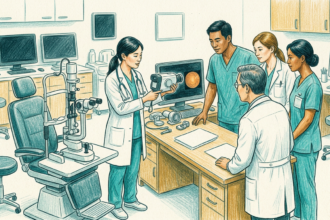


The PRIMA Implant System
A clinical trial led by Stanford Medicine has demonstrated that a wireless retinal implant can restore functional reading ability to patients with advanced age-related macular degeneration. The PRIMA chip, measuring just 2 millimeters wide, is surgically placed beneath the retina and works in conjunction with a camera embedded in smart glasses. The camera captures visual information and projects it via infrared light to the implant, which converts these signals into electrical impulses that stimulate the remaining retinal cells, effectively bypassing the damaged photoreceptors.
The system allows patients to perceive shapes and patterns, a level of vision known as form vision. Unlike previous prosthetic devices that only provided light sensitivity, this technology represents a breakthrough in restoring usable sight. The smart glasses also include adjustable zoom and contrast enhancement features, enabling patients to customize their visual experience based on their immediate environment.
Impact on Patients and Future Directions
In the study published in the New England Journal of Medicine, 27 of 32 participants regained the ability to read within one year of receiving the implant. Some patients achieved visual sharpness equivalent to 20/42 vision, sufficient for reading books, recognizing faces, and identifying street signs. For healthcare providers treating age-related macular degeneration, this technology offers hope for patients who have exhausted other treatment options.
Researchers are now developing higher-resolution versions of the implant that could potentially provide near-normal vision in the future. For ophthalmology departments and vision rehabilitation centers, this advancement signals a potential shift in how end-stage retinal disease is managed, though widespread clinical adoption will require additional regulatory approvals and manufacturing scale-up.
Source: Sciencedaily