

By using this site, you agree to the Privacy Policy and Terms of Use.
Accept
MedsparkMedsparkMedspark
  • Home
  • News & Alerts
    News & AlertsShow More
    Ion Based Memristors Create Hardware Neurons That Mirror Brain Function
    By
    msadmin
    July 6, 2026
    Deep learning pipeline pinpoints anatomical source of snoring from audio alone
    By
    msadmin
    July 5, 2026
    AI Model Generates Future Knee X-Rays to Predict Osteoarthritis Progression
    By
    msadmin
    July 1, 2026
    Baptist Health Deploys AI Platform to Close Gaps in Incidental Finding Follow-Up
    By
    msadmin
    June 30, 2026
    Google’s AMIE AI Advances from Diagnosis to Long-Term Disease Management in New Nature Study
    By
    msadmin
    June 30, 2026
  • Spotlight
    SpotlightShow More
    Strategic healthcare AI governance framework abstract illustration
    Building a Resilient Healthcare AI Strategy: Insights from Industry Leaders
    By
    msadmin
    May 15, 2026
    Pharma AI Alliance Expands: Owkin and AstraZeneca Deploy New Drug Discovery Models
    By
    msadmin
    May 14, 2026
    7 Must-Attend MedTech Events in South Africa for 2025
    By
    Jostel Owusu
    August 9, 2025
    EY Expert Urges Healthcare Leaders to Double Down on AI Amid Economic Uncertainty
    By
    Yu Chi Huang
    July 11, 2025
    Medow Health AI Launches Real-Time AI Scribe in Singapore to Boost Clinical Efficiency
    By
    Yu Chi Huang
    July 4, 2025
  • Articles
    ArticlesShow More
    AI in Surgical Research: How Large Language Models Are Accelerating Medical Discovery at the Medical College of Wisconsin
    By
    msadmin
    June 30, 2026
    Why Radiologists Reject Standalone AI: The Case for Seamless Workflow Integration
    By
    msadmin
    June 30, 2026
    Bridging the Gap: Translating AI Innovations into Neurological Practice
    By
    msadmin
    June 30, 2026
    Stress Tests Reveal Critical Gaps in AI Medical Reasoning Despite Top Benchmark Scores
    By
    msadmin
    June 30, 2026
    Designing Healthcare AI for Real World Clinical Flow
    By
    msadmin
    June 30, 2026
  • Events
    EventsShow More
    Stanford Health AI Week Highlights AI’s Growing Role in Medical Education, Patient Empowerment, and Life Sciences
    By
    msadmin
    June 19, 2026
    HIMSS APAC 2026: Re-engineering APAC Health Systems in the AI Era
    By
    msadmin
    June 9, 2026
    AIMed 2026: Bridging the Gap Between AI Promise and Clinical Reality in Kraków
    By
    msadmin
    April 30, 2026
    7 Must-Attend MedTech Events in South Africa for 2025
    By
    Jostel Owusu
    August 9, 2025
    Cleveland Clinic’s First AI Summit Signals Bold Future for Healthcare
    By
    msadmin
    July 19, 2025
  • About
    • Mission
    • Services
    • Contact
Font ResizerAa
MedsparkMedspark
Font ResizerAa
  • Home
  • News & Alerts
  • Spotlight
  • Articles
  • Events
  • About
  • Quick Links
    • Home
    • News & Alerts
    • Spotlight
    • Articles
    • Events
  • About MedSpark
    • Our Purpose & Vision
    • Services
    • Contact
Follow US
News & Alerts

Ion Based Memristors Create Hardware Neurons That Mirror Brain Function

MSAdmin
By
msadmin
MSAdmin
Bymsadmin
MedTech AI & Cybersecurity News
Follow:
Published: July 6, 2026
Share
2 Min Read
SHARE

A Hardware Leap Toward Brain Like Computing

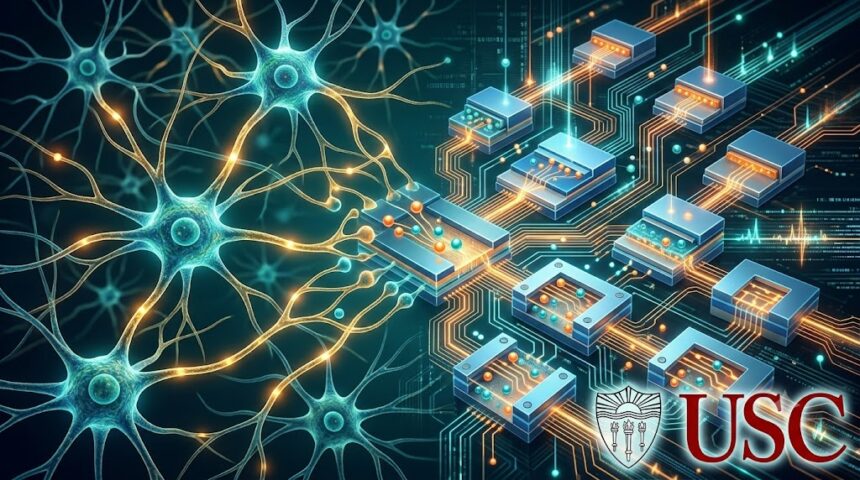
Researchers at the University of Southern California have developed artificial neurons that physically replicate the electrochemical behavior of biological brain cells, a breakthrough for neuromorphic computing. Unlike traditional digital processors that simulate neural activity through software models, these new devices use actual ion motion within diffusive memristors to generate electrical pulses that mimic how real neurons process and transmit signals. The work, published in Nature Electronics, demonstrates a significantly more compact design where each artificial neuron fits within the footprint of a single transistor, compared to the tens or hundreds required by earlier approaches.

Contents
A Hardware Leap Toward Brain Like ComputingEfficiency Gains and Future Potential

Efficiency Gains and Future Potential

The technology uses silver ions embedded in oxide materials to reproduce fundamental brain processes such as learning, movement, and planning. This approach offers substantial advantages in energy efficiency, with the potential to reduce chip size and power consumption by orders of magnitude compared to conventional silicon based systems. The researchers note that while current silver based materials are not yet compatible with standard semiconductor manufacturing processes, future work will explore alternative ionic materials. The next phase involves integrating large numbers of these artificial neurons and synapses to test how closely the hardware can replicate the brain’s efficiency and capabilities, potentially enabling artificial general intelligence systems that learn from few examples while consuming minimal energy.

Source: Sciencedaily

TAGGED:Artificial Neuronsdiffusive memristorhardwareion dynamics
Share This Article
Facebook Copy Link Print
MSAdmin
Bymsadmin
Follow:
MedTech AI & Cybersecurity News
banner-medspark-horiz

You Might Also Like

News & Alerts

AI Model Generates Future Knee X-Rays to Predict Osteoarthritis Progression

By
msadmin
July 1, 2026
News & Alerts

Healthy.io’s Smartphone-Powered Kidney Test Shows Promise in Early CKD Detection Through Home-Based Screening Pilot

By
Yu Chi Huang
June 23, 2025
News & Alerts

AI Adoption Surges in French Healthcare, but Outdated IT Systems Slow Digital Transformation

By
Yu Chi Huang
June 18, 2025
News & Alerts

Qure.ai Expands AI Super User Training to U.S., Empowering Radiology Professionals for an AI-Driven Future

By
Yu Chi Huang
June 16, 2025
Facebook Twitter Youtube Linkedin
Quick Links
  • News & Alerts
  • Articles
  • Spotlight
  • Events
About Medspark
  • Mission
  • Services
  • Contact

© Copyright 2026 MedSpark. All rights reserved.

Privacy Policy | Legal