
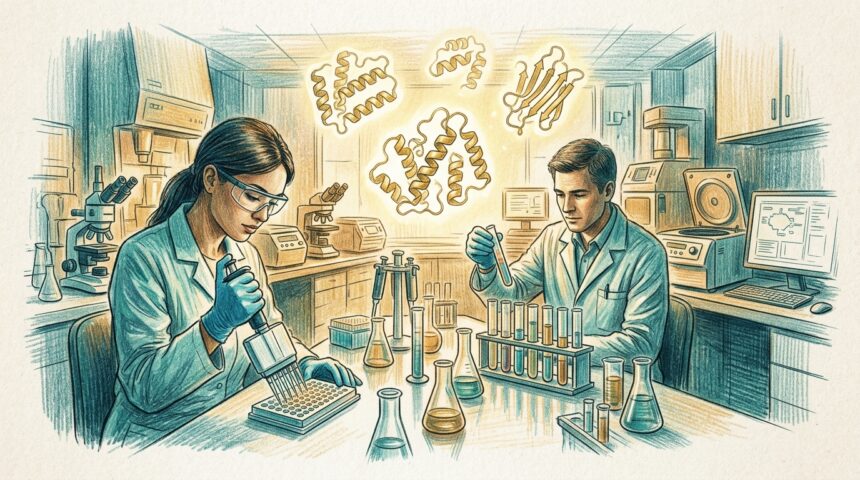
AI-designed minibinders can hit cancer surface proteins, but a new Nature Communications study shows their success depends heavily on the target. Researchers screened thousands of AI-generated minibinders using mammalian cell-surface display and found several high-affinity binders against PD-L1, yet far fewer against CD276 (B7-H3) and VTCN1 (B7-H4).
The team used interface predicted template modeling (ipTM) scores from Chai-1, combined with ESM embeddings, to predict which designs would bind. The scores tracked experimental success and flagged deleterious interface mutations, giving drug hunters a cheaper filter before wet-lab work.
Fluorophore-labeled AI minibinders stained cells about as well as conventional antibodies in flow cytometry. But when wired into chimeric antigen receptors (CARs), several showed poor cell-surface trafficking and limited function. A genetic algorithm-based redesign that kept binding interfaces intact while altering non-binding surfaces uncovered an isoelectric point window that improved CAR expression and target-selective tumor cell killing.
The takeaway: reaching the binding interface is only half the problem. The authors argue biochemical optimization beyond the interface is a critical requirement for turning AI-designed proteins into working therapeutics. For companies racing to deploy protein design models, the study is a reminder that validation throughput, not just generation, decides what reaches the clinic.