
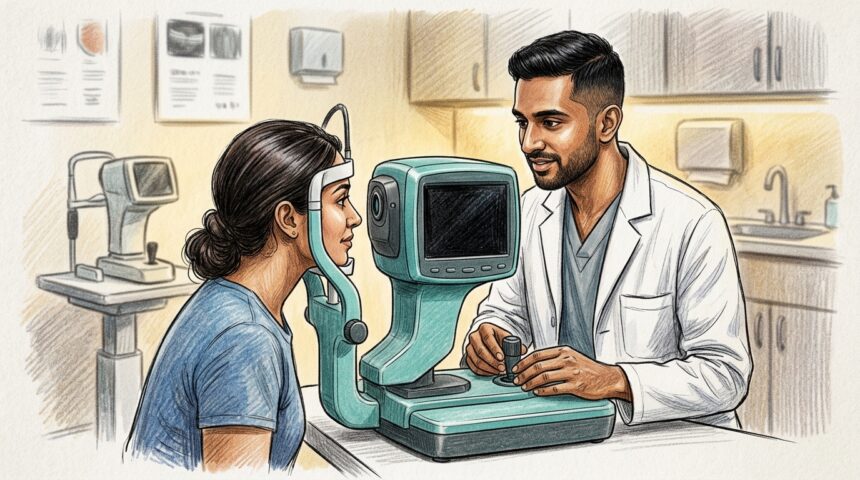
Researchers have built an AI system that automates the entire OCT retina diagnostic pipeline, from image quality check to patient-level diagnosis, and it matches ophthalmologists on accuracy.
FOCUS, short for Full-process OCT-based Clinical Utility System, runs a foundation model-driven workflow. It first scores scan quality, then flags abnormalities and classifies disease using a fine-tuned vision foundation model. A unified adaptive aggregation step combines 2D slice predictions into a 3D patient-level verdict.
The system was trained on 3,300 patients (40,672 slices) and externally validated on 1,345 patients (18,498 slices) across four centers with different OCT devices. It hit F1 scores of 99 percent for quality assessment, 97.5 percent for abnormality detection, and 94.4 percent for patient-level diagnosis, with real-world performance ranging from 90.2 to 95.2 percent.
In head-to-head comparisons, FOCUS edged out experts on abnormality detection (95.5 vs 90.9) and multi-disease diagnosis (93.5 vs 91.4) while reading faster.
The study, published in npj Digital Medicine, positions FOCUS as a step toward autonomous screening that could expand retinal care to populations without easy access to specialists. Diabetic retinopathy and age-related macular degeneration remain leading causes of blindness, and OCT automation is seen as one path to closing the screening gap. External validation across real-world centers will be key to whether the system holds up outside research settings.