


By using this site, you agree to the Privacy Policy and Terms of Use.
Accept
MedsparkMedsparkMedspark
  • Home
  • News & Alerts
    News & AlertsShow More
    Ohio State and Microsoft build a hospital that senses itself
    By
    msadmin
    November 11, 2026
    Charta raises $55M to settle claims before doctors bill
    By
    msadmin
    November 11, 2026
    Oura spends $625M to put doctors behind its ring
    By
    msadmin
    November 11, 2026
    Google puts an agent layer under every hospital workflow
    By
    msadmin
    November 11, 2026
    XtalPi hands Pierre Fabre a molecule factory for stubborn cancer targets
    By
    msadmin
    November 10, 2026
  • Spotlight
    SpotlightShow More
    Robinhood Ventures Fund II brings retail capital to healthcare AI
    By
    msadmin
    August 13, 2026
    Adialante brings accessible MRI-based cancer screening
    By
    msadmin
    August 11, 2026
    CellType models biology so AI can discover drugs
    By
    msadmin
    August 11, 2026
    Healthcare AI startups in Robinhood Ventures Fund II
    By
    msadmin
    August 11, 2026
    OpenAI launches GPT-Rosalind for life sciences research
    By
    msadmin
    July 17, 2026
  • Articles
    ArticlesShow More
    Singapore clinics let an AI watch for referrals nobody ever sent
    By
    msadmin
    November 1, 2026
    An AI team of agents grades immunotherapy side effects
    By
    msadmin
    October 30, 2026
    Brain implant decoders fail when patients or hardware change, review warns
    By
    msadmin
    October 25, 2026
    Proteomics model picks breast cancer drugs from biopsies
    By
    msadmin
    September 10, 2026
    CRISP model reads frozen sections to steer cancer surgery
    By
    msadmin
    September 10, 2026
  • About
    • Mission
    • Services
    • Contact
  • Shop
    • All Items
    • By Category
    • Cart
  • Newsletter
Font ResizerAa
MedsparkMedspark
Font ResizerAa
  • Home
  • News & Alerts
  • Spotlight
  • Articles
  • About
  • Shop
  • Newsletter
  • Home
  • News & Alerts
  • Spotlight
  • Articles
  • About
    • Mission
    • Services
    • Contact
  • Shop
    • All Items
    • By Category
    • Cart
  • Newsletter
Follow US
News & Alerts

Routine CT scans get a second read for hidden bone loss

A Shanghai team showed commercial AI can mine ordinary CT scans for osteoporosis, turning routine imaging into opportunistic bone screening.

MedSpark Staff
By
msadmin
MedSpark Staff
Bymsadmin
Medical, Healthcare, & Biotech/Pharma AI News
Follow:
Published: October 10, 2026
Share
2 Min Read
SHARE

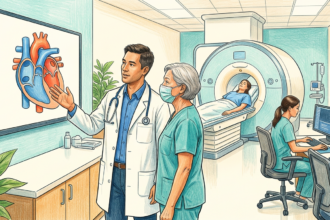
Millions of CT scans are ordered every day for chest pain, trauma or cancer staging. Bone density is rarely the reason. A new study in BMC Medical Imaging suggests that useful skeletal information is sitting unread inside those images, and that off-the-shelf AI can extract it.

Researchers at Changzheng Hospital of Naval Medical University in Shanghai tested whether a commercial deep learning tool could judge bone quality from routine non-contrast lumbar CT. They enrolled 518 patients who had undergone both a CT and the standard dual-energy X-ray absorptiometry, or DXA, scan, allowing a head-to-head comparison in the same people.

Each patient was sorted into one of three categories based on DXA: normal, osteopenia or osteoporosis. The AI, built on convolutional neural networks, then graded the CT images alone. The goal was not to replace DXA but to catch the many patients who never get one.

Why the screening gap matters

Osteoporosis is silent by design. Bone mineral drains for decades without pain until a hip, spine or wrist fracture suddenly changes a life. Effective drugs exist, but they only help once the condition is found. DXA is cheap, fast and safe, yet it is chronically underused, especially among older adults in primary care.

That is the case for opportunistic screening. If a scan already exists, asking software a second question costs almost nothing and adds no radiation and no appointment.

The Shanghai work is retrospective and single-country, so it is a proof of concept rather than a deployment. Still, it points to a practical shift: the value of routine imaging may lie as much in what it incidentally reveals as in the question it was ordered to answer.
TAGGED:clinical researchdeep learningdiagnosticsMedical ImagingOsteoporosisRadiology AI
SOURCES:Bioengineer.org
Share This Article
Facebook Copy Link Print
MedSpark Staff
Bymsadmin
Follow:
Medical, Healthcare, & Biotech/Pharma AI News

You Might Also Like

News & Alerts

Heartvue’s cardiac MRI AI clears FDA with self-update built in

By
msadmin
September 5, 2026
News & Alerts

Lilly’s TuneLab network adds two wet-lab data partners

By
msadmin
September 18, 2026
News & Alerts

Ceribell’s AI EEG readers clear FDA review

By
msadmin
August 14, 2026
News & Alerts

KINESSENSOR Project Unveils AI-Powered Wearable Tech to Revolutionize Musculoskeletal Disorder Treatment

By
Yu Chi Huang
June 11, 2025

AI news, analysis, and insights for healthcare, biotech, and pharma.

Facebook Twitter Youtube Linkedin
Quick Links
  • News & Alerts
  • Articles
  • Spotlight
  • Events
About Medspark
  • Mission
  • Services
  • Contact

© Copyright 2026 MedSpark. All rights reserved.

Privacy Policy | Legal