
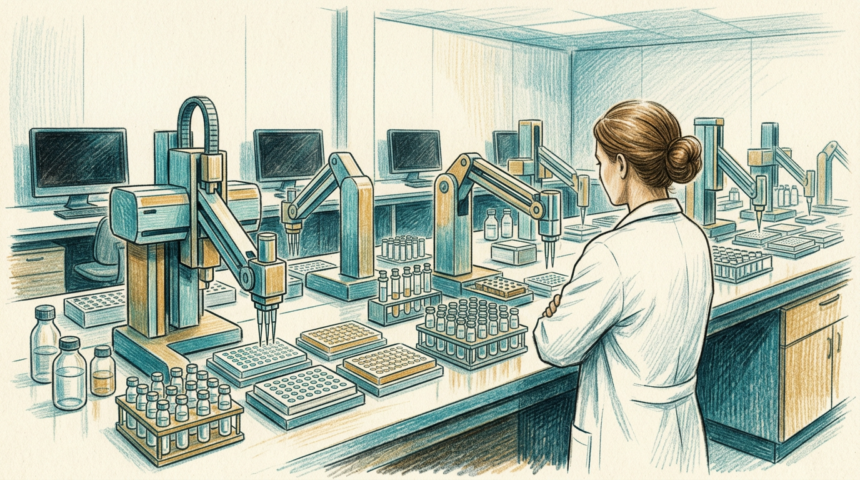
Roche used its pharmaceutical investor day on September 28 to describe a research operation that increasingly runs itself. Aviv Regev, who leads research and early development at Genentech, said the Swiss group is pursuing what it calls AI independence and has started building autonomous, AI-driven laboratories.
The financial frame is blunt. About CHF 2B ($2.41B) released by research and development savings will be pushed into programs and productivity work. Roche expects as many as 20 new molecular entities to reach the market by 2030, and it reported a phase III success rate above 80% so far in 2026, up from 65% across 2025.
Computational tools are already inside the decision chain. Between the fourth quarter of 2025 and the second quarter of 2026, 40% of pipeline decisions carried a tracked AI or computational contribution. Roche also expects Target Nexus, its in-house research system, to touch 80% of portfolio decisions by the end of 2026.
What the group has not spelled out is how much of a discovery program can run unattended, who signs off when a model proposes a molecule, or how regulators will treat data generated inside a closed loop. Those gaps matter, because automation moves the bottleneck from running experiments to judging them.