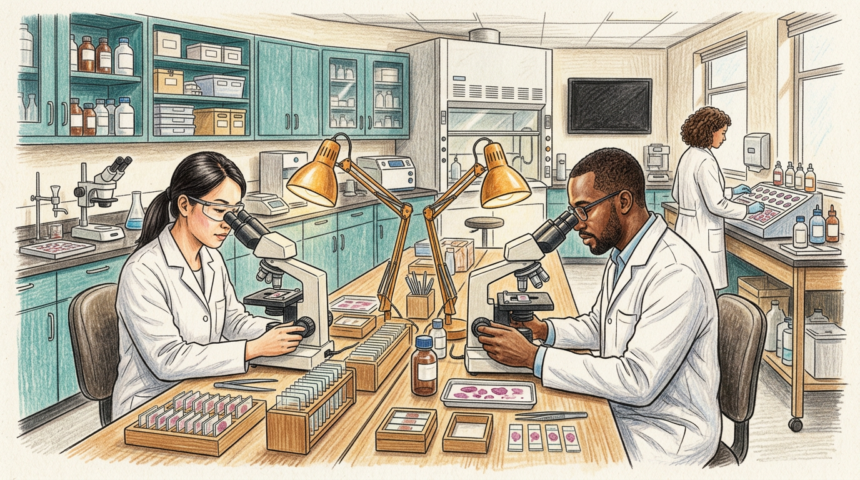
Before a drug candidate reaches a first human trial, pathologists read thousands of tissue sections looking for damage caused by the compound. The hard part is the rare finding: a focal lesion that occupies less than 1% of a slide and can look like ordinary biological variation.
AstraZeneca is now testing whether foundation models can help spot those changes. Boston-based Tremont AI, which announced a research collaboration with the company on October 27, will develop and evaluate AI for preclinical toxicologic pathology – the safety assessment that decides whether a molecule moves forward.
Where the model came from
Tremont spun out of the Mahmood Lab at Mass General Brigham and has an exclusive technology license from the hospital system. Scientific co-founders include Faisal Mahmood, who directs the Mass General Brigham AI Institute, and Long Phi Le, who leads computational pathology at Massachusetts General Hospital.
Its TRACE research trained on 15 million image patches from digitized rat tissue sections, then tested tasks including lesion severity scoring and dose-response characterization. The point of a foundation model is reuse: one representation serving many toxicology questions instead of a bespoke model per study.
The broader AstraZeneca bet
There is a family link. Mahmood and Le co-founded Modella AI, which AstraZeneca acquired this year as part of a push into multimodal foundation models. Tremont addresses a much earlier question than the company’s existing computational pathology work: not which patients will respond, but whether a compound is safe enough to test in people.
Tremont CEO Luca Weishaupt positions foundation models as tools that make interpretation measurable and reproducible, freeing specialists from repetitive review. AstraZeneca is calling it a research collaboration, with no product, regulatory submission or clinical timeline attached.