
Google DeepMind has built a set of Cheminformatics Skills for Google Antigravity, its agentic coding surface, and says the tools can compress a medicinal chemistry iteration from several days into about an hour.
What the agent actually does
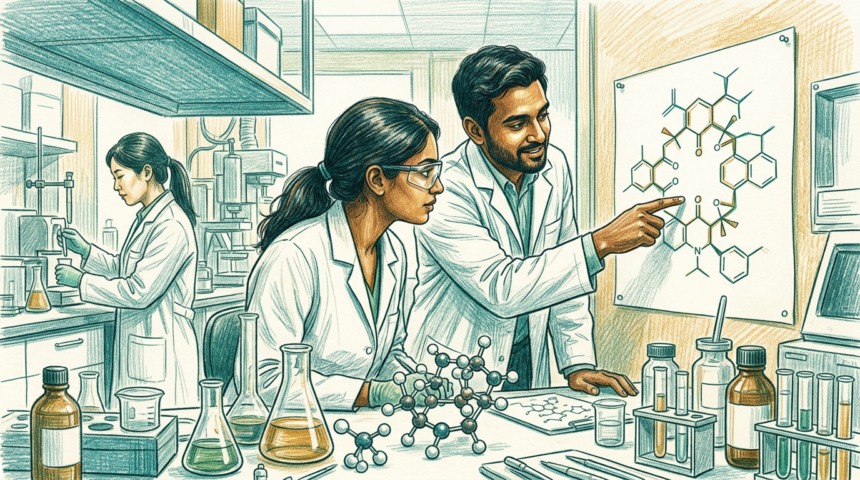
The walkthrough published on November 3 runs on crizotinib and lorlatinib, two kinase inhibitors used in non-small cell lung cancer. Given a prompt, the agent pulls thousands of compounds out of academic and patent literature, discards solvents and buffers, documents provenance and builds an interactive viewer.
From there it performs matched molecular pair analysis, trains potency models on a held-out scaffold split, and proposes rigidified macrocycles with synthetic routes.
Reasoning and calculation stay separate
The division of labour is the design choice that matters. The language model handles orchestration, database navigation and scientific reasoning. Deterministic chemistry tools do the arithmetic, anchored in RDKit, with connectors to ChEMBL and PubChem.
That split matters because a single altered atom describes a different compound. Molecular work tolerates less improvisation than prose.
What DeepMind says it cannot do
The company is unusually direct about limits. Sparse data, inter-lab assay noise and narrow dynamic ranges cap predictive precision. Computational designs are testable hypotheses, not finished drugs, and every proposal still needs synthesis and experimental validation.
The skills ship with the Antigravity Science plugin. DeepMind is also offering 10,000 scientists its highest usage tier free for six months on a rolling basis.
For medicinal chemists, the pitch is not a faster model. It is fewer days spent reconciling the same molecule written four different ways.