

By using this site, you agree to the Privacy Policy and Terms of Use.
Accept
MedsparkMedsparkMedspark
  • Home
  • News & Alerts
    News & AlertsShow More
    Samsung spinoff wins FDA clearance for AI ECG analysis software
    By
    msadmin
    October 11, 2026
    FDA clears software that builds 3D bone from a routine spine MRI
    By
    msadmin
    October 11, 2026
    Vitalize raises $31M to run hospitals like air traffic control
    By
    msadmin
    October 11, 2026
    Healthleap nets $38M to catch what hospital charts hide
    By
    msadmin
    October 11, 2026
    A robotics upstart banks $75M to build drugs without hands
    By
    msadmin
    October 11, 2026
  • Spotlight
    SpotlightShow More
    Robinhood Ventures Fund II brings retail capital to healthcare AI
    By
    msadmin
    August 13, 2026
    Adialante brings accessible MRI-based cancer screening
    By
    msadmin
    August 11, 2026
    CellType models biology so AI can discover drugs
    By
    msadmin
    August 11, 2026
    Healthcare AI startups in Robinhood Ventures Fund II
    By
    msadmin
    August 11, 2026
    OpenAI launches GPT-Rosalind for life sciences research
    By
    msadmin
    July 17, 2026
  • Articles
    ArticlesShow More
    Proteomics model picks breast cancer drugs from biopsies
    By
    msadmin
    September 10, 2026
    CRISP model reads frozen sections to steer cancer surgery
    By
    msadmin
    September 10, 2026
    Consumer chatbots are building a medical system outside hospitals
    By
    msadmin
    August 21, 2026
    Reasoning gaps hold back AI agents in scientific discovery
    By
    msadmin
    August 11, 2026
    Benchmark scores can’t track real clinical LLM use, Stanford says
    By
    msadmin
    August 11, 2026
  • About
    • Mission
    • Services
    • Contact
  • Shop
    • All Items
    • By Category
    • Cart
  • Newsletter
Font ResizerAa
MedsparkMedspark
Font ResizerAa
  • Home
  • News & Alerts
  • Spotlight
  • Articles
  • About
  • Shop
  • Newsletter
  • Home
  • News & Alerts
  • Spotlight
  • Articles
  • About
    • Mission
    • Services
    • Contact
  • Shop
    • All Items
    • By Category
    • Cart
  • Newsletter
Follow US
ArticlesSpotlight

Microsoft AI Outperforms Physicians in Complex Diagnostic Challenge With New MAI-DxO Tool

Yu Chi Huang
By
Yu Chi Huang
Yu Chi Huang
ByYu Chi Huang
Yu Chi is a senior regulatory affairs specialist and medical researcher focusing on medical devices.
Published: June 30, 2025
Share
3 Min Read
SHARE

As first reported by GeekWire, Microsoft has introduced the MAI-DxO (Microsoft AI Diagnostic Orchestrator), a cutting-edge artificial intelligence tool designed to tackle complex diagnostic challenges. In a head-to-head trial using 304 difficult cases from the New England Journal of Medicine, MAI-DxO achieved an 85.5% diagnostic accuracy rate — vastly outperforming a group of 21 U.S. and U.K. physicians, who correctly diagnosed only 20% of the same cases.

Contents
Designed to mimic clinical reasoning and reduce costsBeyond textbook knowledge: real-world diagnostic simulationNot a replacement, but an augmentation

Designed to mimic clinical reasoning and reduce costs

MAI-DxO approaches diagnosis much like a human clinician: it evaluates symptoms, asks questions, and suggests follow-up tests. One of its core advantages is its cost-conscious design, which helps reduce unnecessary diagnostics — a common driver of excess healthcare spending. Microsoft developed the system by integrating various top-tier AI models, with its most effective configuration running on OpenAI’s o3.
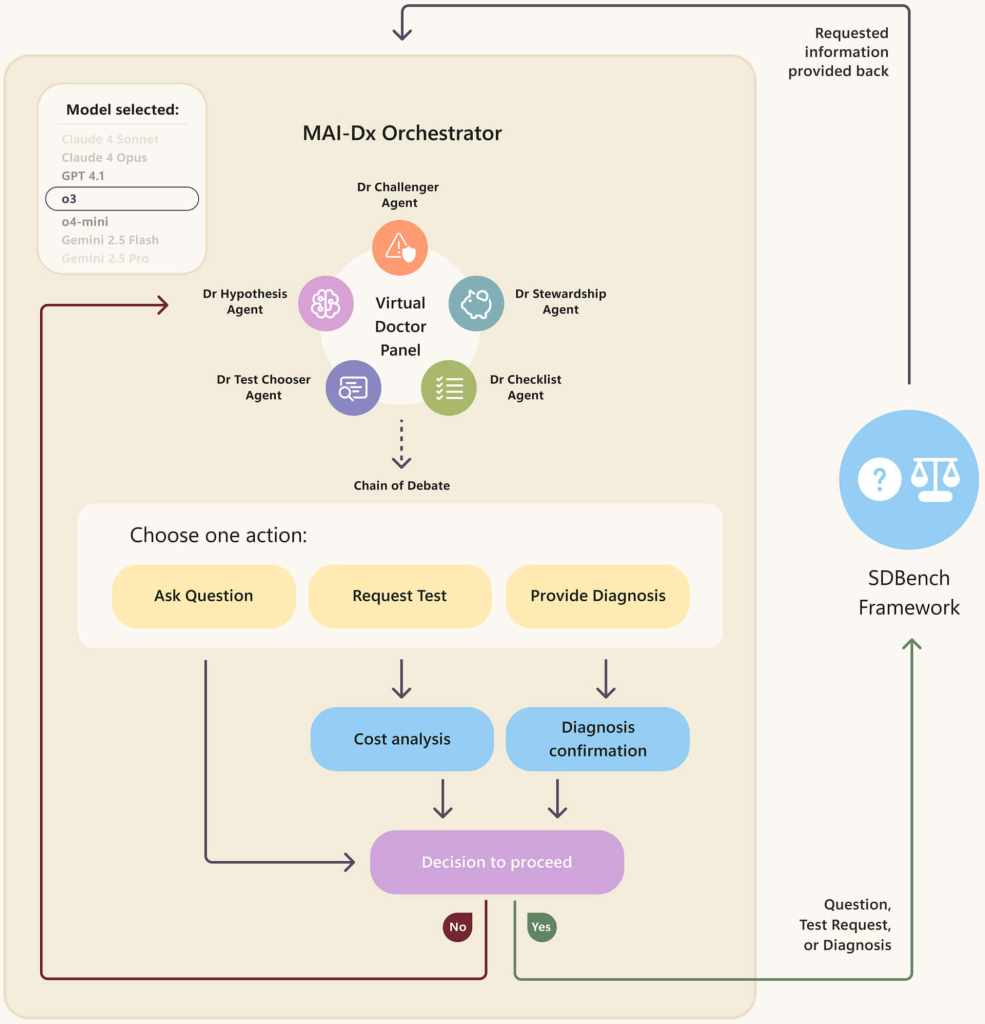
Source: microsoft.ai.

Beyond textbook knowledge: real-world diagnostic simulation

Unlike earlier benchmarks that relied on multiple-choice tests like the USMLE, this trial pushed MAI-DxO into the realm of “sequential diagnosis,” a process that mirrors how real physicians reach conclusions through iterative reasoning. Microsoft emphasized that the tool’s superior performance in these realistic scenarios is an indicator of how far AI in medicine has advanced, though it acknowledged that in real practice, doctors work collaboratively and use reference materials, which weren’t available in the test setup.

Not a replacement, but an augmentation

Microsoft leaders including CEO of Microsoft AI, Mustafa Suleyman, and VP of Health, Bay Gross, were clear in their vision: MAI-DxO isn’t meant to replace doctors but to augment them. The AI is positioned as a tool to assist in streamlining clinical workflows, guiding diagnoses, and creating personalized treatment strategies. The next phase will involve validating the system in clinical settings and against more routine medical cases, with regulatory approval required before deployment.

Microsoft’s MAI-DxO sets a new bar in AI-assisted diagnostics, showcasing the ability of advanced models to tackle complex, real-world medical reasoning tasks. As the company works toward clinical integration, its emphasis on responsible, collaborative AI suggests a future where human physicians and intelligent systems work hand in hand to enhance diagnostic accuracy and healthcare efficiency.


VIA:GeekWire
Share This Article
Facebook Copy Link Print
Yu Chi Huang
ByYu Chi Huang
Yu Chi is a senior regulatory affairs specialist and medical researcher focusing on medical devices.

You Might Also Like

ArticlesNews & Alerts

Bipartisan senators probe Medicare Advantage AI care denials

By
msadmin
July 17, 2026
Articles

AI Partnerships and Imaging Advances Reshape Clinical Workflows in Health Systems

By
msadmin
June 17, 2026
Spotlight

OpenAI launches GPT-Rosalind for life sciences research

By
msadmin
July 17, 2026
Articles

AI Scribes Ease Clinician Burden but Raise Privacy and Safety Concerns in Australia’s Hospitals

By
Yu Chi Huang
July 7, 2025

AI news, analysis, and insights for healthcare, biotech, and pharma.

Facebook Twitter Youtube Linkedin
Quick Links
  • News & Alerts
  • Articles
  • Spotlight
  • Events
About Medspark
  • Mission
  • Services
  • Contact

© Copyright 2026 MedSpark. All rights reserved.

Privacy Policy | Legal