
By using this site, you agree to the Privacy Policy and Terms of Use.
Accept
MedsparkMedsparkMedspark
  • Home
  • News & Alerts
    News & AlertsShow More
    AI takes center stage in 2026 Prix Galien USA nominee list
    By
    msadmin
    August 26, 2026
    Open-ended AI diagnosis lags multiple choice in brain scans
    By
    msadmin
    August 26, 2026
    Healthcare LLM code leaks API keys at a rising rate
    By
    msadmin
    August 26, 2026
    Suki unbundles voice notes for Epic and MEDITECH hospitals
    By
    msadmin
    August 26, 2026
    AI physio firm Sword Health to buy mental health app Headspace
    By
    msadmin
    August 26, 2026
  • Spotlight
    SpotlightShow More
    Robinhood Ventures Fund II brings retail capital to healthcare AI
    By
    msadmin
    August 13, 2026
    Adialante brings accessible MRI-based cancer screening
    By
    msadmin
    August 11, 2026
    CellType models biology so AI can discover drugs
    By
    msadmin
    August 11, 2026
    Healthcare AI startups in Robinhood Ventures Fund II
    By
    msadmin
    August 11, 2026
    OpenAI launches GPT-Rosalind for life sciences research
    By
    msadmin
    July 17, 2026
  • Articles
    ArticlesShow More
    Consumer chatbots are building a medical system outside hospitals
    By
    msadmin
    August 21, 2026
    Reasoning gaps hold back AI agents in scientific discovery
    By
    msadmin
    August 11, 2026
    Benchmark scores can’t track real clinical LLM use, Stanford says
    By
    msadmin
    August 11, 2026
    Teladoc puts 100 percent of fees at risk with new AI-powered platform
    By
    msadmin
    July 27, 2026
    Johns Hopkins finds frontier AI agents fail most complex health tasks
    By
    msadmin
    July 27, 2026
  • About
    • Mission
    • Services
    • Contact
  • Shop
    • All Items
    • By Category
    • Cart
  • Newsletter
Font ResizerAa
MedsparkMedspark
Font ResizerAa
  • Home
  • News & Alerts
  • Spotlight
  • Articles
  • About
  • Shop
  • Newsletter
  • Home
  • News & Alerts
  • Spotlight
  • Articles
  • About
    • Mission
    • Services
    • Contact
  • Shop
    • All Items
    • By Category
    • Cart
  • Newsletter
Follow US
Articles

How Machine Learning Is Reshaping Pharmaceutical R&D

AI is reshaping pharmaceutical R&D from target identification through clinical trial optimization, compressing drug discovery timelines and unlocking therapeutic targets conventional methods cannot reach.

MedSpark Staff
By
msadmin
MedSpark Staff
Bymsadmin
Medical, Healthcare, & Biotech/Pharma AI News
Follow:
Published: July 12, 2026
Share
4 Min Read
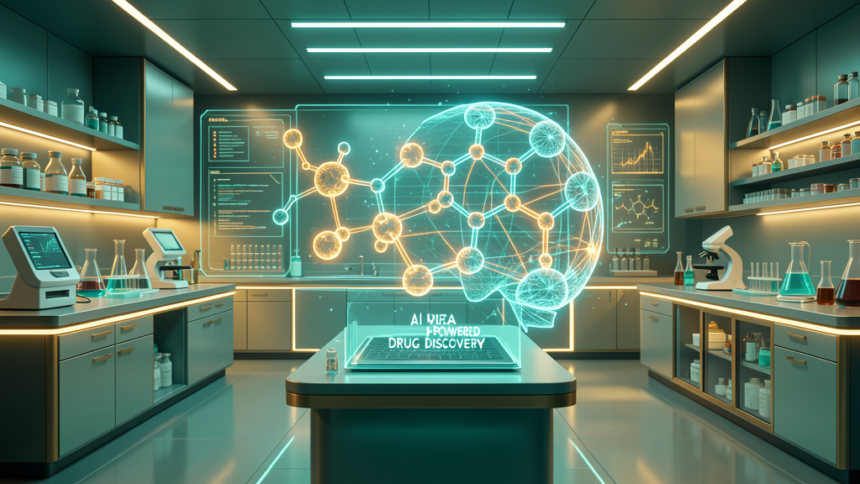
AI-powered drug discovery concept showing a holographic molecular structure analyzed by neural networks in a sleek pharmaceutical laboratory with teal and gold lighting
SHARE

The pharmaceutical industry has long operated on a 10-to-15-year development cycle with billion-dollar price tags and a 90 percent failure rate for drugs entering clinical trials. Artificial intelligence is now challenging that paradigm at every stage, from target identification through clinical trial optimization, promising to compress timelines, reduce costs, and unlock therapeutic targets that conventional methods cannot reach.

Contents
The Molecular Screening RevolutionGenerative Models for Novel ChemistryProtein Structure Prediction as a Foundational LayerClinical Trial Optimization and Patient SelectionChallenges and Limitations

The Molecular Screening Revolution

Traditional drug discovery begins with high-throughput screening — testing millions of compounds against a biological target in the hope of finding a few promising candidates. AI-driven approaches flip this model on its head. Instead of brute-force screening, machine learning models trained on chemical libraries, protein structures, and known bioactivity data can predict which molecules are most likely to bind to a target before any wet-lab work begins.

Companies like Insilico Medicine, Recursion Pharmaceuticals, and BenevolentAI have demonstrated that AI-discovered candidates can reach clinical trials in a fraction of the typical timeline. Insilico’s AI-designed drug for idiopathic pulmonary fibrosis, for example, went from target identification to Phase I clinical trials in under 30 months — a process that conventionally takes five to seven years.

Generative Models for Novel Chemistry

Perhaps the most transformative application is generative AI for molecular design. Rather than screening existing compounds, generative models can create entirely novel molecular structures optimized for specific therapeutic properties.

This is a fundamentally different approach from traditional medicinal chemistry, where researchers iteratively modify known scaffolds. Generative models can explore chemical space far beyond human intuition, identifying novel chemotypes that would likely never be discovered through conventional methods.

Protein Structure Prediction as a Foundational Layer

AlphaFold’s ability to predict protein structures with near-experimental accuracy has given drug discovery AI systems a critical input previously available only through costly experimental methods. More recent developments extend these capabilities to protein-ligand complexes and protein-protein interactions, enabling AI to model how potential drugs will interact with targets before any laboratory synthesis.

Clinical Trial Optimization and Patient Selection

AI’s impact extends beyond the laboratory into clinical development. Machine learning models can analyze electronic health records, genomic data, and real-world evidence to identify patient populations most likely to respond to a given therapy, enabling more efficient trial designs with smaller sample sizes and higher probability of success.

Challenges and Limitations

Despite the promise, AI-driven drug discovery faces significant challenges. The quality of training data remains a bottleneck — historical pharmaceutical data is fragmented, often proprietary, and biased toward successful programs. AI models also struggle with the fundamental unpredictability of biology. Regulatory frameworks for AI-designed therapeutics are still evolving, and questions about explainability remain unresolved.

For healthcare leaders watching this space, the message is clear: the traditional pharmaceutical R&D model is undergoing its most significant structural change in decades, and AI is the driving force.

TAGGED:AI Drug DiscoveryClinical AIdrug discoveryGenerative AIGenomicsMachine Learningpharmaceutical
SOURCES:The Medical Futurist
Share This Article
Facebook Copy Link Print
MedSpark Staff
Bymsadmin
Follow:
Medical, Healthcare, & Biotech/Pharma AI News

You Might Also Like

News & Alerts

Beyang banks $30M to push AI-designed eye and blood drugs

By
msadmin
August 13, 2026
News & Alerts

AWS becomes Novo Nordisk’s preferred AI partner for drug discovery

By
msadmin
August 10, 2026
News & Alerts

Nature review catalogs the attack surface of clinical LLMs

By
msadmin
August 20, 2026
News & Alerts

NeuroVFM trains on 5 million clinical scans to build a generalist brain AI

By
msadmin
July 17, 2026

AI news, analysis, and insights for healthcare, biotech, and pharma.

Facebook Twitter Youtube Linkedin
Quick Links
  • News & Alerts
  • Articles
  • Spotlight
  • Events
About Medspark
  • Mission
  • Services
  • Contact

© Copyright 2026 MedSpark. All rights reserved.

Privacy Policy | Legal