
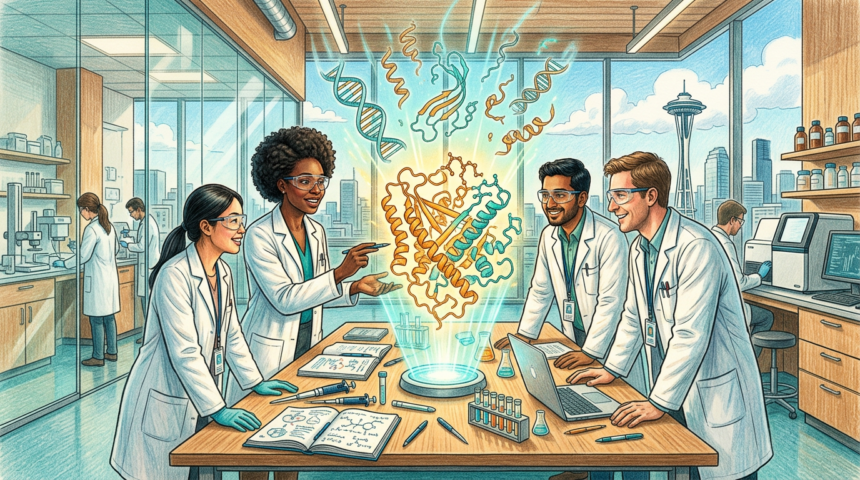
The Allen Institute, the University of Washington and Fred Hutch Cancer Center have pooled resources behind AI BioDesign, a research accelerator aimed at making biological engineering as predictable as software engineering.
The Seattle initiative, backed by the Fund for Science and Technology, will build AI models, datasets, assays and tools for designing biology with applications in precision medicine and beyond. Its long-term goal, according to lead scientific directors David Baker and Jay Shendure, is to turn biology into a discipline where systems can be engineered with the same reliability as mechanical or electrical systems.
Baker, who leads the UW Medicine Institute for Protein Design, said the pace of AI is finally matching the experimental power of synthetic biology. That shift changes the question from what nature has already made to what else is possible and how to test it, he said. Shendure, who directs the Brotman Baty Institute for Precision Medicine, will co-lead the effort.
The accelerator brings together the Allen Institute’s track record in large-scale open science platforms, UW’s expertise in protein design and genome science, and Fred Hutch’s translational cancer research. Sanjay Srivatsan, a Fred Hutch principal investigator, said his team plans to scale up genomic datasets so AI can find patterns that inspire new therapeutic designs.
AI BioDesign says it will release models, datasets, assays, reagents and benchmarks to the community as open resources.