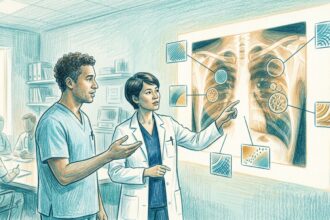

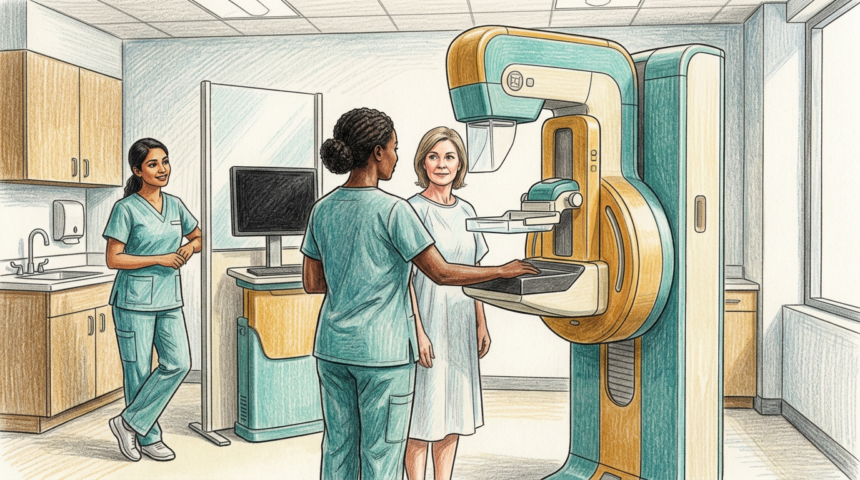
Breast tissue changes between screenings carry information that a single scan misses. A deep-learning model built at NYU Langone Health exploits that signal to estimate five-year breast cancer risk.
Called NYU-DRP, the tool reads longitudinal digital breast tomosynthesis, the accumulated record of annual 3D mammograms. Training data came from 313,531 yearly scans belonging to 161,165 women, all imaged at NYU Langone hospitals from 2016 through 2020.
Accuracy favored the multi-year model. It ranked higher-risk women correctly 72 percent of the time. Restricting the input to the newest 3D mammogram dropped that figure to 70 percent, and AI-assisted 2D mammography reached 68 percent.
Traditional assessment trailed further behind. The Tyrer-Cuzick questionnaire draws on family history and clinical factors instead of images, and it hit 56 percent on the same five-year question. NYU-DRP reached 67 percent.
The study appeared online in the American Journal of Roentgenology. Yanqi Xu, a postdoctoral research fellow in radiology at NYU Grossman School of Medicine, was lead investigator.
Any risk score used to set screening intervals has to stay calibrated across populations. The authors describe their work as single-center and retrospective, so wider validation would come before such a tool could guide decisions about extra imaging.