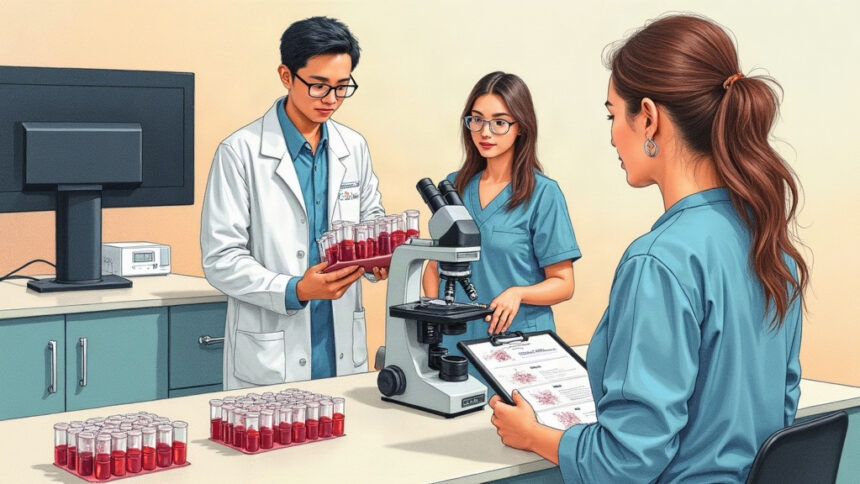
A Singapore research programme argues that the routine complete blood count already carries far more information than clinicians currently draw from it, and it intends to build frontier AI models to find out.
BloodCounts! is the first healthcare project taken in by CARES, the Cambridge research centre in Singapore, which is now thirteen years old. Two hospital partners signed on at launch, the National University Health System and SingHealth, alongside teams from Singapore and Britain.
The pitch rests on scale and waste. Health systems run roughly 10 million CBC tests every day, and much of the signal inside those results goes unread. No fresh blood draws are needed: the project means to mine data already sitting in laboratory systems.
Leading the effort are Michael Roberts, a professor at Cambridge, and Weisi Lin of Nanyang Technological University. The goal is to spot subtle shifts in blood cells tied to a range of diseases, which would feed early diagnosis, prognosis and clinical decisions.
This is not a new venture. The consortium began with NIHR Biomedical Research Centre data at Cambridge University Hospitals, spread to Barts Health and University College London Hospitals, and has since crossed continents. The consortium now reaches Belgium, The Gambia, Ghana, India and the Netherlands, and NUHS and SingHealth are its first partners from Singapore.
Roberts, a research professor in Cambridge’s applied mathematics and theoretical physics department, framed the multi-continent spread as a scientific requirement rather than a strategic one. Pooling hospitals in Europe, Africa and Asia, he said, supplies the patient diversity needed to build models that serve everyone equitably.
No model accuracy results have been published yet. Money comes from an award by Singapore’s National Research Foundation under its AI-for-Science initiative, which counts the project as one of eight it is backing.