By using this site, you agree to the Privacy Policy and Terms of Use.
Accept
MedsparkMedsparkMedspark
  • Home
  • News & Alerts
    News & AlertsShow More
    Atlas Bio leaves stealth with $12.5M to test drugs on simulated patients
    By
    msadmin
    October 27, 2026
    Practo’s founder banks $15M to screen healthy Indians for hidden disease
    By
    msadmin
    October 27, 2026
    Heartflow hauls a second rival into court over cardiac CT software
    By
    msadmin
    October 27, 2026
    Coreline Soft adds aortic measurements to its chest CT platform
    By
    msadmin
    October 27, 2026
    A self-taught model rebuilds blood flow maps from paediatric heart scans
    By
    msadmin
    October 27, 2026
  • Spotlight
    SpotlightShow More
    Robinhood Ventures Fund II brings retail capital to healthcare AI
    By
    msadmin
    August 13, 2026
    Adialante brings accessible MRI-based cancer screening
    By
    msadmin
    August 11, 2026
    CellType models biology so AI can discover drugs
    By
    msadmin
    August 11, 2026
    Healthcare AI startups in Robinhood Ventures Fund II
    By
    msadmin
    August 11, 2026
    OpenAI launches GPT-Rosalind for life sciences research
    By
    msadmin
    July 17, 2026
  • Articles
    ArticlesShow More
    Brain implant decoders fail when patients or hardware change, review warns
    By
    msadmin
    October 25, 2026
    Proteomics model picks breast cancer drugs from biopsies
    By
    msadmin
    September 10, 2026
    CRISP model reads frozen sections to steer cancer surgery
    By
    msadmin
    September 10, 2026
    Consumer chatbots are building a medical system outside hospitals
    By
    msadmin
    August 21, 2026
    Reasoning gaps hold back AI agents in scientific discovery
    By
    msadmin
    August 11, 2026
  • About
    • Mission
    • Services
    • Contact
  • Shop
    • All Items
    • By Category
    • Cart
  • Newsletter
Font ResizerAa
MedsparkMedspark
Font ResizerAa
  • Home
  • News & Alerts
  • Spotlight
  • Articles
  • About
  • Shop
  • Newsletter
  • Home
  • News & Alerts
  • Spotlight
  • Articles
  • About
    • Mission
    • Services
    • Contact
  • Shop
    • All Items
    • By Category
    • Cart
  • Newsletter
Follow US
News & Alerts

A self-taught model rebuilds blood flow maps from paediatric heart scans

Children's National and Purdue researchers cut 4D flow MRI processing from an hour to minutes without any hand-drawn segmentation.

MedSpark Staff
By
msadmin
MedSpark Staff
Bymsadmin
Medical, Healthcare, & Biotech/Pharma AI News
Follow:
Published: October 27, 2026
Share
2 Min Read
SHARE

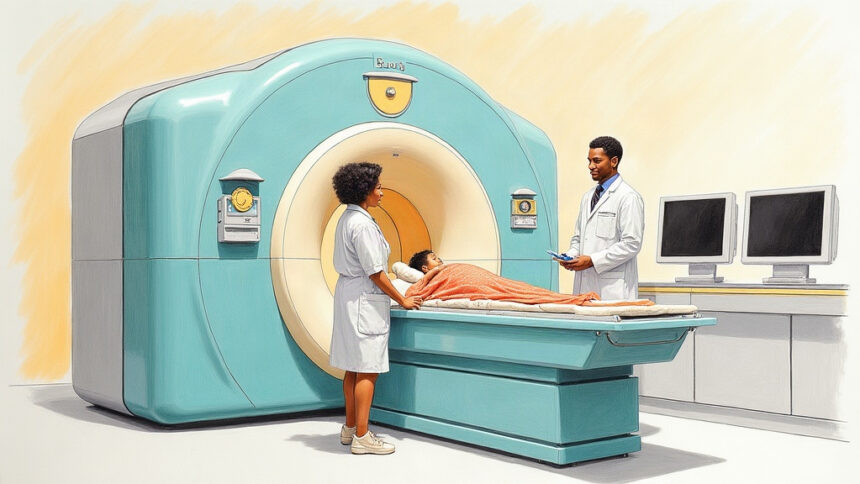
Engineers at Purdue University and Children’s National have piloted SMURF, an artificial intelligence framework that rebuilds blood flow through a child’s heart from four-dimensional flow MRI, with no clinician tracing the vessel walls by hand. The results appeared in Medical Image Analysis.

Contents
Tested on Fontan circulationThe bottleneck it removes

The name stands for Scalable Method for Unsupervised Reconstruction of Flow, and the word unsupervised is the point. The system does not need scans that someone has already labelled. It reads the MRI signal and velocity measurements in tandem, then assembles an anatomy-and-flow model built around the individual patient.

Children are exactly where that matters. Their hearts are smaller, beat faster, and are frequently rebuilt by surgery, all of which leaves supervised tools trained on adult images badly out of their depth. Big labelled datasets of paediatric scans are also close to nonexistent.

Tested on Fontan circulation

Twelve paediatric and young adult cases formed the test set: eight had Fontan circulation, the rerouted plumbing used for single-ventricle hearts, and four had normal anatomy. Human expert tracings and an FDA-cleared clinical processing pipeline served as references.

Its automated segmentations tracked the experts closely, and its flow fields held together more physically than the commercial pipeline’s did. A single graphics processing unit finished each patient in roughly 4.7 to 11.4 minutes.

The bottleneck it removes

4D flow MRI shows how blood swirls and accelerates through the heart, detail that ordinary imaging cannot capture. Analysis has always been the catch: semi-automated workflows ate an hour or more per patient and drifted depending on who did the tracing.

Twelve cases are a pilot, not a validated product, and the authors present the work as a demonstration rather than a cleared tool.


TAGGED:4D flow MRIcongenital heart diseaseMedical Imagingpediatric cardiologyresearchunsupervised learning
SOURCES:Children's National Innovation District
Share This Article
Facebook Copy Link Print
MedSpark Staff
Bymsadmin
Follow:
Medical, Healthcare, & Biotech/Pharma AI News

You Might Also Like

News & Alerts

Oracle Health gives nurses a voice AI agent inside the EHR

By
msadmin
September 19, 2026
News & Alerts

Deutsche Telekom’s venture arm buys into Tandem Health’s clinical assistant

By
msadmin
October 27, 2026
News & Alerts

Pharmacy AI suite at Singapore’s NUHS reclaims 850 staff hours a week

By
msadmin
August 1, 2026
News & Alerts

Skin AI explanations help doctors while biasing everyday users

By
msadmin
August 7, 2026

AI news, analysis, and insights for healthcare, biotech, and pharma.

Facebook Twitter Youtube Linkedin
Quick Links
  • News & Alerts
  • Articles
  • Spotlight
  • Events
About Medspark
  • Mission
  • Services
  • Contact

© Copyright 2026 MedSpark. All rights reserved.

Privacy Policy | Legal