Drugs reach hospital shelves only after decades of trial and error. A Beijing startup wants that compressed. An extension led by China Life Capital carried BioGeometry’s Series A past $100 million. Its generative models design biomolecules from scratch rather than screening libraries, targeting candidates in weeks instead of the 10 to 15 years a new medicine usually takes.
Shanghai Biomedical Industry Fund, already invested, wrote a larger check, joined by China Development Venture Capital, Guofang Venture Capital, Reliance Investment and other industry backers. Dacheng Wealth Capital raised its stake; Index Capital was sole adviser. China Life Capital called it a benchmark for the country’s AI-native biotech sector. Two years earlier, pre-A money came from Zhipu AI and Gaorong Capital behind Jiangmen Ventures.
Barely four years old, it runs two engines. GeoFlow handles molecules, predicting structures and designing new ones with all-atom accuracy. Its June 2024 debut matched AlphaFold 3 on protein complexes; V2 in April 2025 was billed as the first Chinese model doing de novo antibody design; V3 last October added a loop that generates, scores and refines. Screening over 20 targets, it landed candidates inside three weeks at a 20% average hit rate. A larger V4 is in development.
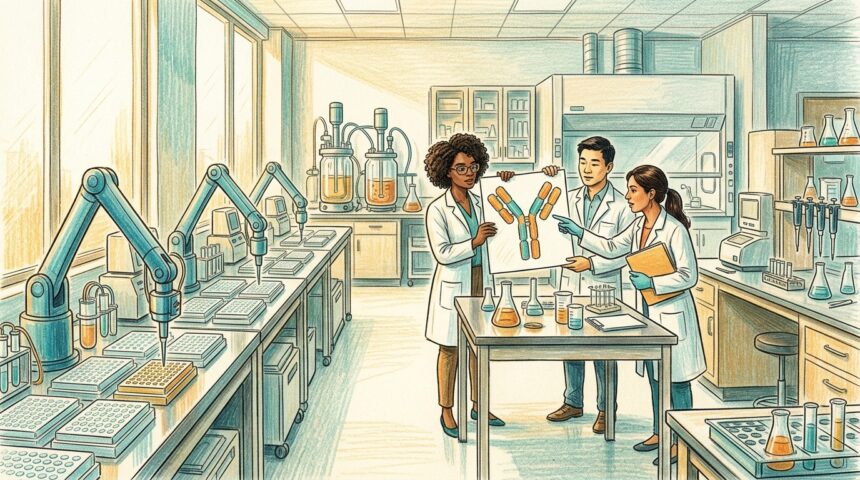
GeoCell zooms out, modeling how cells respond to genes, drugs or combinations, guiding target, disease and patient choices. An AI agent chains both systems to automated labs so each experiment informs the next.
The capital upgrades both platforms, expands high-throughput labs and pushes internal pipelines toward market. Dozens of projects are queued, and several bispecific antibodies should reach IND filing in 2027. It also says it was first to biosynthesize natural borneol, a traditional medicine compound, at about 80% below plant extraction cost, with large-scale revenue expected in 2027.