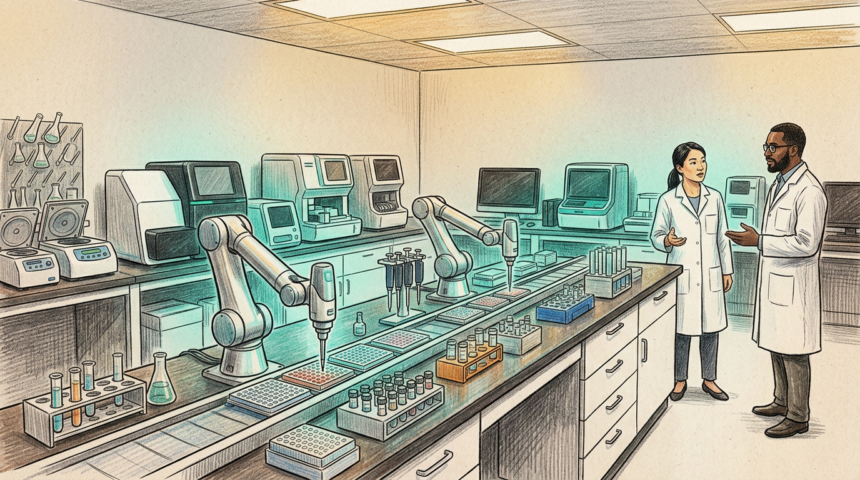
Most self-driving labs automate one instrument. AutoDNA, built at Shanghai Jiao Tong University, was designed the other way around: the AI came first and the hardware was assembled around it.
The system, described in Nature on November 4, coordinates more than 20 types of instrument and executed 11,382 hardware operations during one DNA data-storage run that lasted about 203 hours. A human typed a prompt. Agents chose the protocol, sequenced the DNA and read the stored message back out.
What the agents actually did
It synthesized and sequenced 78 DNA strands to store a sentence in the four nucleotide letters and restored the text exactly. In another project it found and confirmed a KRAS G13D mutation in a clinical sample, the kind of variant that guides colorectal and lung cancer treatment.
It also matched the enzymatic DNA synthesis yield that human experts had tuned by hand, and cut the wall-clock time of concurrent workflows to roughly a third.
Why the architecture matters
Earlier platforms bolted AI onto existing equipment, so the model saw slices of a protocol, not the whole lab. Co-author Haibo Chen said human experts were still configuring instruments in most prior systems. AutoDNA instead treats every device as an agent-callable tool under one shared plan.
Humans were not entirely absent. Researchers restocked reagents and serviced hardware when the system asked. Stanford’s James Zou, writing a companion commentary, noted that AI can propose a bioactive molecule in minutes while verifying it in a lab still takes weeks – a gap this work narrows.
The code is on GitHub under the IPADS-X organization. The team frames the result as a blueprint for science as a service rather than a single molecule.