By using this site, you agree to the Privacy Policy and Terms of Use.
Accept
MedsparkMedsparkMedspark
  • Home
  • News & Alerts
    News & AlertsShow More
    A Shanghai lab turns its whole bench over to AI agents
    By
    msadmin
    November 5, 2026
    Britain’s Sovereign AI bets seed money on physics instead of wet labs
    By
    msadmin
    November 5, 2026
    AI measures heart function more consistently than expert readers
    By
    msadmin
    November 5, 2026
    AstraZeneca tests AI on the tissue slides that decide drug safety
    By
    msadmin
    November 5, 2026
    Evident Vascular clears FDA hurdle with a fully AI native IVUS console
    By
    msadmin
    November 5, 2026
  • Spotlight
    SpotlightShow More
    Robinhood Ventures Fund II brings retail capital to healthcare AI
    By
    msadmin
    August 13, 2026
    Adialante brings accessible MRI-based cancer screening
    By
    msadmin
    August 11, 2026
    CellType models biology so AI can discover drugs
    By
    msadmin
    August 11, 2026
    Healthcare AI startups in Robinhood Ventures Fund II
    By
    msadmin
    August 11, 2026
    OpenAI launches GPT-Rosalind for life sciences research
    By
    msadmin
    July 17, 2026
  • Articles
    ArticlesShow More
    Singapore clinics let an AI watch for referrals nobody ever sent
    By
    msadmin
    November 1, 2026
    An AI team of agents grades immunotherapy side effects
    By
    msadmin
    October 30, 2026
    Brain implant decoders fail when patients or hardware change, review warns
    By
    msadmin
    October 25, 2026
    Proteomics model picks breast cancer drugs from biopsies
    By
    msadmin
    September 10, 2026
    CRISP model reads frozen sections to steer cancer surgery
    By
    msadmin
    September 10, 2026
  • About
    • Mission
    • Services
    • Contact
  • Shop
    • All Items
    • By Category
    • Cart
  • Newsletter
Font ResizerAa
MedsparkMedspark
Font ResizerAa
  • Home
  • News & Alerts
  • Spotlight
  • Articles
  • About
  • Shop
  • Newsletter
  • Home
  • News & Alerts
  • Spotlight
  • Articles
  • About
    • Mission
    • Services
    • Contact
  • Shop
    • All Items
    • By Category
    • Cart
  • Newsletter
Follow US
News & Alerts

AstraZeneca tests AI on the tissue slides that decide drug safety

Tremont AI will build and evaluate foundation models that help pathologists spot treatment-related tissue damage before a compound reaches human trials.

MedSpark Staff
By
msadmin
MedSpark Staff
Bymsadmin
Medical, Healthcare, & Biotech/Pharma AI News
Follow:
Published: November 5, 2026
Share
2 Min Read
SHARE

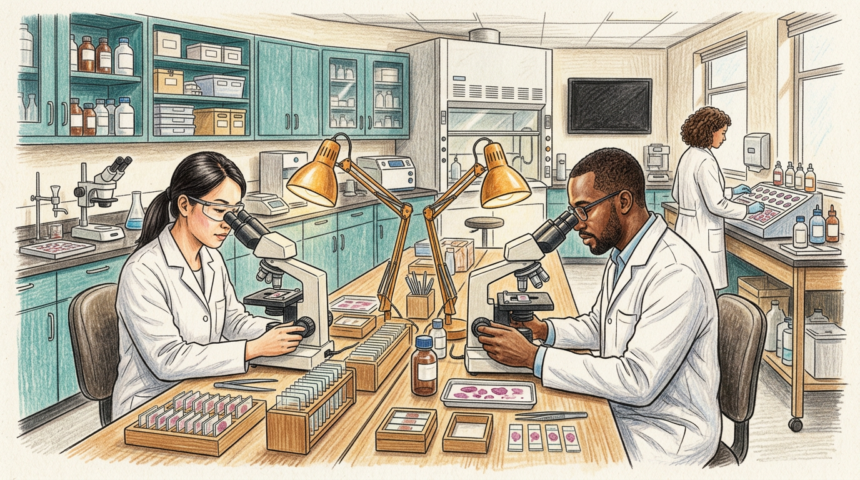
Before a drug candidate reaches a first human trial, pathologists read thousands of tissue sections looking for damage caused by the compound. The hard part is the rare finding: a focal lesion that occupies less than 1% of a slide and can look like ordinary biological variation.

Contents
Where the model came fromThe broader AstraZeneca bet

AstraZeneca is now testing whether foundation models can help spot those changes. Boston-based Tremont AI, which announced a research collaboration with the company on October 27, will develop and evaluate AI for preclinical toxicologic pathology – the safety assessment that decides whether a molecule moves forward.

Where the model came from

Tremont spun out of the Mahmood Lab at Mass General Brigham and has an exclusive technology license from the hospital system. Scientific co-founders include Faisal Mahmood, who directs the Mass General Brigham AI Institute, and Long Phi Le, who leads computational pathology at Massachusetts General Hospital.

Its TRACE research trained on 15 million image patches from digitized rat tissue sections, then tested tasks including lesion severity scoring and dose-response characterization. The point of a foundation model is reuse: one representation serving many toxicology questions instead of a bespoke model per study.

The broader AstraZeneca bet

There is a family link. Mahmood and Le co-founded Modella AI, which AstraZeneca acquired this year as part of a push into multimodal foundation models. Tremont addresses a much earlier question than the company’s existing computational pathology work: not which patients will respond, but whether a compound is safe enough to test in people.

Tremont CEO Luca Weishaupt positions foundation models as tools that make interpretation measurable and reproducible, freeing specialists from repetitive review. AstraZeneca is calling it a research collaboration, with no product, regulatory submission or clinical timeline attached.


TAGGED:AstraZenecaComputational pathologyDrug SafetyFoundation Modelspreclinical researchToxicologyTremont AI
SOURCES:Tremont AIAIM Media House
Share This Article
Facebook Copy Link Print
MedSpark Staff
Bymsadmin
Follow:
Medical, Healthcare, & Biotech/Pharma AI News

You Might Also Like

News & Alerts

GenBio launches stateful AIDO Cell to simulate whole human cells

By
msadmin
August 19, 2026
News & Alerts

New MALP Prediction Method Shows Promise for Medical Data Accuracy

By
msadmin
June 30, 2026
News & Alerts

PRISM reads plain MRI to spot liver tumors without contrast dye

By
msadmin
August 19, 2026
News & Alerts

Brainomix finds a routine CT signal for stroke drug responders

By
msadmin
October 29, 2026

AI news, analysis, and insights for healthcare, biotech, and pharma.

Facebook Twitter Youtube Linkedin
Quick Links
  • News & Alerts
  • Articles
  • Spotlight
  • Events
About Medspark
  • Mission
  • Services
  • Contact

© Copyright 2026 MedSpark. All rights reserved.

Privacy Policy | Legal