

By using this site, you agree to the Privacy Policy and Terms of Use.
Accept
MedsparkMedsparkMedspark
  • Home
  • News & Alerts
    News & AlertsShow More
    Anthropic Warning: Chip Export Limits Could Weaken Healthcare AI Access
    By
    msadmin
    May 21, 2026
    Pharma AI Alliance Expands: Owkin and AstraZeneca Deploy New Drug Discovery Models
    By
    msadmin
    May 14, 2026
    Pennsylvania Targets AI Chatbots That Pose as Licensed Doctors
    By
    msadmin
    May 5, 2026
    M42 and GE HealthCare Partner to Advance AI-Driven Smart Healthcare in the UAE
    By
    Yu Chi Huang
    July 14, 2025
    HL7 Launches Dedicated AI Office to Drive Global Standards for Ethical Healthcare Innovation
    By
    Yu Chi Huang
    July 8, 2025
  • Spotlight
    SpotlightShow More
    Strategic healthcare AI governance framework abstract illustration
    Building a Resilient Healthcare AI Strategy: Insights from Industry Leaders
    By
    msadmin
    May 15, 2026
    Pharma AI Alliance Expands: Owkin and AstraZeneca Deploy New Drug Discovery Models
    By
    msadmin
    May 14, 2026
    EY Expert Urges Healthcare Leaders to Double Down on AI Amid Economic Uncertainty
    By
    Yu Chi Huang
    July 11, 2025
    Medow Health AI Launches Real-Time AI Scribe in Singapore to Boost Clinical Efficiency
    By
    Yu Chi Huang
    July 4, 2025
    Guangdong Medical University Launches China’s First AI Medical School to Lead Future Healthcare Education
    By
    Yu Chi Huang
    July 2, 2025
  • Articles
    ArticlesShow More
    Strategic healthcare AI governance framework abstract illustration
    Building a Resilient Healthcare AI Strategy: Insights from Industry Leaders
    By
    msadmin
    May 15, 2026
    Gene Editing Breakthroughs and AI Risks: A Health Sector View of 2026’s Defining Tech
    By
    msadmin
    May 12, 2026
    Bridging the Gap Between AI Adoption and HIPAA Compliance
    By
    msadmin
    May 6, 2026
    EY Expert Urges Healthcare Leaders to Double Down on AI Amid Economic Uncertainty
    By
    Yu Chi Huang
    July 11, 2025
    Google Unveils Open-Source Medical AI Models That See, Read, and Assist Like Real Clinicians
    By
    Yu Chi Huang
    July 10, 2025
  • Events
    EventsShow More
    Cleveland Clinic’s First AI Summit Signals Bold Future for Healthcare
    By
    msadmin
    July 19, 2025
    Experts Urge Cautious Adoption of Agentic AI in Healthcare Workflows at HIMSS AI Forum
    By
    Yu Chi Huang
    July 11, 2025
    New Zealand Accelerates Healthcare Innovation With AI and 24/7 Virtual Care Services
    By
    Yu Chi Huang
    July 7, 2025
    Aidoc and Nvidia Launch BRIDGE to Streamline and Scale Safe Clinical AI Adoption
    By
    Yu Chi Huang
    June 18, 2025
    UK’s Brightest AI4Health Researchers Shine at National Doctoral Conference in York
    By
    msadmin
    June 11, 2025
  • About
    • Mission
    • Services
    • Contact
Font ResizerAa
MedsparkMedspark
Font ResizerAa
  • Home
  • News & Alerts
  • Spotlight
  • Articles
  • Events
  • About
  • Quick Links
    • Home
    • News & Alerts
    • Spotlight
    • Articles
    • Events
  • About MedSpark
    • Our Purpose & Vision
    • Services
    • Contact
Follow US
Articles

Google Unveils Open-Source Medical AI Models That See, Read, and Assist Like Real Clinicians

MedGemma and MedSigLIP models are designed to interpret medical images and text together, offering healthcare systems low-cost, high-accuracy AI that enhances—not replaces—clinical care.

Yu Chi Huang
By
Yu Chi Huang
Yu Chi Huang
ByYu Chi Huang
Yu Chi is a senior regulatory affairs specialist and medical researcher focusing on medical devices.
Published: July 10, 2025
Share
3 Min Read
SHARE

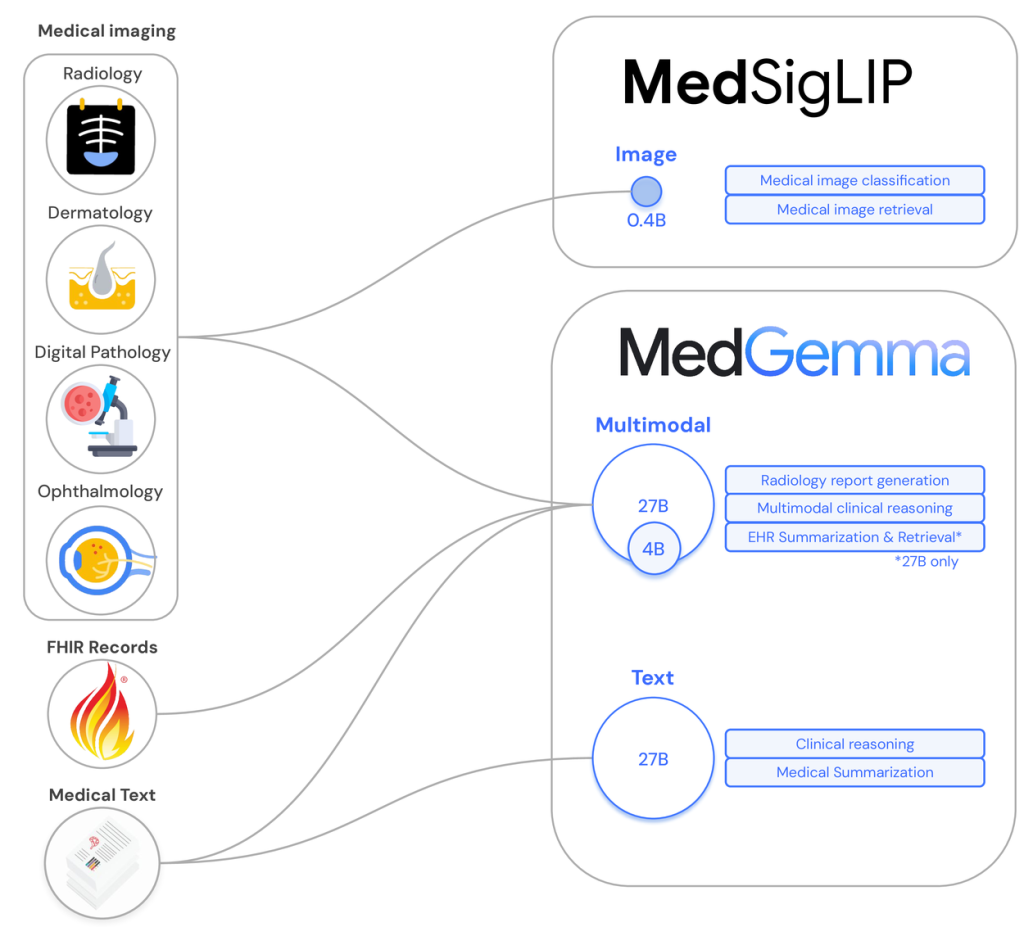
As first reported by AI News, Google has introduced a suite of open-source AI models—MedGemma 27B, MedGemma 4B, and MedSigLIP—designed specifically for healthcare. These models go beyond reading medical text; they can now interpret medical images such as chest X-rays, pathology slides, and dermatology photos alongside longitudinal patient records. The flagship MedGemma 27B model scored an impressive 87.7% on the MedQA benchmark while remaining far cheaper to run than larger, general-purpose models. This performance marks a significant step toward real-world clinical AI support, especially for under-resourced systems.
Source: research.google.

Its smaller sibling, MedGemma 4B, is optimized for efficiency but still delivers meaningful results, scoring 64.4% on the same benchmark. Radiologists reviewing its chest X-ray reports deemed 81% accurate enough to assist in patient care. Meanwhile, MedSigLIP, a lightweight vision-language model trained specifically on medical images, offers capabilities that general AI models lack—such as identifying medically significant patterns and enabling case-based image retrieval through multimodal understanding.

Real-world adoption signals practical value

Several global healthcare institutions are already piloting these models. DeepHealth in the U.S. reports that MedSigLIP aids in spotting issues radiologists might overlook, while Chang Gung Memorial Hospital in Taiwan confirms MedGemma’s effective use with traditional Chinese medical texts. In India, Tap Health has highlighted MedGemma’s notable strength: it avoids the factual hallucinations typical of general AI, maintaining clinical relevance and accuracy when context matters most. This reliability could prove vital as healthcare workflows increasingly integrate AI.

Google’s decision to open-source these models is key to their potential. It allows hospitals to deploy the AI locally, ensuring patient data never leaves their premises, while enabling researchers and developers to fine-tune the models for region-specific medical challenges. The models are lightweight enough to run on single GPUs and even mobile devices, democratizing access to high-quality AI tools in low-resource settings.

Google’s release of the MedGemma and MedSigLIP models signals a major advance in accessible, medically literate AI tools that respect both clinical standards and local data needs. These open-source models won’t replace doctors—but they offer powerful, affordable support that could expand quality care to regions and providers that need it most. As the global health system faces rising demand and strained resources, tools like these could serve as vital amplifiers of human expertise.


VIA:AINews
Share This Article
Facebook Copy Link Print
Yu Chi Huang
ByYu Chi Huang
Yu Chi is a senior regulatory affairs specialist and medical researcher focusing on medical devices.
banner-medspark-horiz

You Might Also Like

Articles

Taipei Veterans General Hospital Uses AI to Boost Preventive Care and Reduce ‘Unhealthy Years’ in Aging Populations

By
Yu Chi Huang
June 18, 2025
Articles

Gene Editing Breakthroughs and AI Risks: A Health Sector View of 2026’s Defining Tech

By
msadmin
May 12, 2026
ArticlesSpotlight

EY Expert Urges Healthcare Leaders to Double Down on AI Amid Economic Uncertainty

By
Yu Chi Huang
July 11, 2025
Articles

NHS Unveils Radical 10-Year AI-Driven Plan to Transform Healthcare Delivery

By
Yu Chi Huang
July 8, 2025
Facebook Twitter Youtube Linkedin
Quick Links
  • News & Alerts
  • Articles
  • Spotlight
  • Events
About Medspark
  • Mission
  • Services
  • Contact

Subscribe to the MedSpark AI newsletter

Sign up now and don’t miss a single healthcare and medical AI update.

© Copyright 2026 MedSpark. All rights reserved.

Privacy Policy | Legal