
Biological AI has a data problem that compute cannot fix. Models that predict how immune cells respond to a drug need examples of exactly that, and the public supply is thin. Parse Biosciences, a QIAGEN company, and proteomics specialist Nomic Bio think the answer is to manufacture the examples at industrial scale.
The two announced Cascade, a licensable dataset that will pair 100 million single-cell RNA sequencing profiles with more than 11,000 proteomic secretome profiles. It is designed to capture how immune cell types respond to over 150,000 individual and combination perturbations across multiple timepoints.
Sign-ups before the science ships
Cascade has already drawn foundational partner commitments from GSK, Pfizer, Sanofi, Graph Therapeutics and Turbine, a signal that large pharma would rather buy the missing data than wait for it to accrue in the literature.
“Biological AI modeling has hit a data bottleneck,” said Parse leadership in the announcement, noting how little public data measures immune response to key perturbations such as cytokines and other drugs.
Two measurements, one cell
The split matters. RNA sequencing shows what a cell is transcribing; secreted proteins show what it is broadcasting to its neighbors. Nomic chief executive Milad Dagher argued that models of immune biology need both, since protein signals carry the communication that shapes how a response develops.
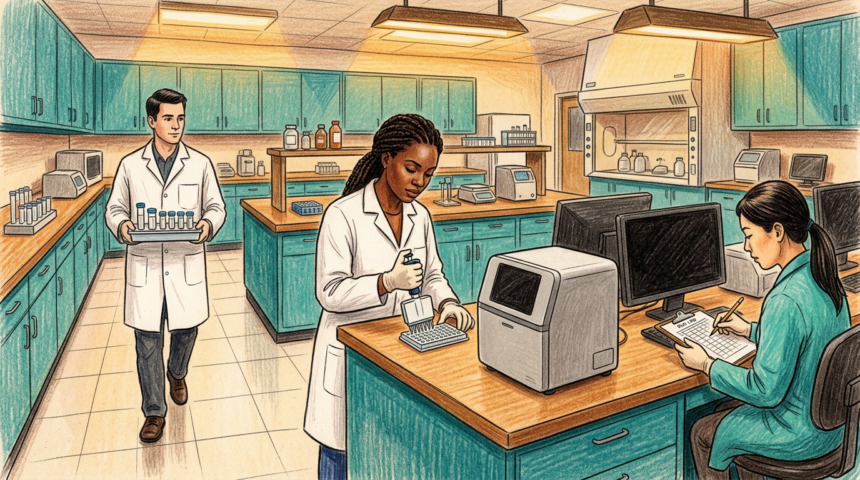
Parse will run the sequencing through GigaLab, its high-throughput service lab capable of profiling billions of cells annually. Nomic’s Omini 1000 platform will measure more than 1,000 secreted proteins per sample, keeping the transcriptomic and proteomic views locked to the same experiments.
The dataset is not open. It is licensed, and the partners describe it as a baseline reference for immune modeling rather than a drug in its own right. Both companies say additional partners are still welcome.