
By using this site, you agree to the Privacy Policy and Terms of Use.
Accept
MedsparkMedsparkMedspark
  • Home
  • News & Alerts
    News & AlertsShow More
    AI takes center stage in 2026 Prix Galien USA nominee list
    By
    msadmin
    August 26, 2026
    Open-ended AI diagnosis lags multiple choice in brain scans
    By
    msadmin
    August 26, 2026
    Healthcare LLM code leaks API keys at a rising rate
    By
    msadmin
    August 26, 2026
    Suki unbundles voice notes for Epic and MEDITECH hospitals
    By
    msadmin
    August 26, 2026
    AI physio firm Sword Health to buy mental health app Headspace
    By
    msadmin
    August 26, 2026
  • Spotlight
    SpotlightShow More
    Robinhood Ventures Fund II brings retail capital to healthcare AI
    By
    msadmin
    August 13, 2026
    Adialante brings accessible MRI-based cancer screening
    By
    msadmin
    August 11, 2026
    CellType models biology so AI can discover drugs
    By
    msadmin
    August 11, 2026
    Healthcare AI startups in Robinhood Ventures Fund II
    By
    msadmin
    August 11, 2026
    OpenAI launches GPT-Rosalind for life sciences research
    By
    msadmin
    July 17, 2026
  • Articles
    ArticlesShow More
    Consumer chatbots are building a medical system outside hospitals
    By
    msadmin
    August 21, 2026
    Reasoning gaps hold back AI agents in scientific discovery
    By
    msadmin
    August 11, 2026
    Benchmark scores can’t track real clinical LLM use, Stanford says
    By
    msadmin
    August 11, 2026
    Teladoc puts 100 percent of fees at risk with new AI-powered platform
    By
    msadmin
    July 27, 2026
    Johns Hopkins finds frontier AI agents fail most complex health tasks
    By
    msadmin
    July 27, 2026
  • About
    • Mission
    • Services
    • Contact
  • Shop
    • All Items
    • By Category
    • Cart
  • Newsletter
Font ResizerAa
MedsparkMedspark
Font ResizerAa
  • Home
  • News & Alerts
  • Spotlight
  • Articles
  • About
  • Shop
  • Newsletter
  • Home
  • News & Alerts
  • Spotlight
  • Articles
  • About
    • Mission
    • Services
    • Contact
  • Shop
    • All Items
    • By Category
    • Cart
  • Newsletter
Follow US
Articles

Global Health Systems Must Unite to Harness AI for Preventive, Personalized Care

AI is poised to transform healthcare by addressing global challenges ranging from antimicrobial resistance to aging populations—if health systems collaborate effectively.

Yu Chi Huang
By
Yu Chi Huang
Yu Chi Huang
ByYu Chi Huang
Yu Chi is a senior regulatory affairs specialist and medical researcher focusing on medical devices.
Published: June 11, 2025
Share
2 Min Read
SHARE

As first reported by China Daily, artificial intelligence is increasingly being recognized as essential to tackling today’s urgent public health crises, including the next pandemic, antimicrobial resistance, and the mental health burden. However, medical data used to train AI presents significant limitations, offering only fragmented glimpses into patients’ health.

Unlike structured data from cameras or sensors, healthcare data is filled with gaps and inaccuracies, making it difficult to build AI systems that understand the full context of a patient’s health journey. To realize AI’s true potential, the focus must shift from reactive to preventive care, by integrating new types of data that reflect the daily lives, habits, and environments of patients.
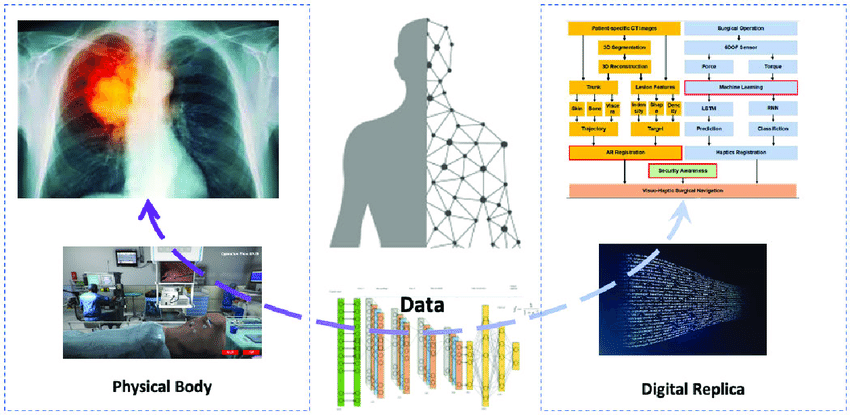
Source: researchgate.net

Currently, many patient-facing health apps and devices target specific diseases, leaving those with multiple chronic conditions overwhelmed. The next evolution in healthcare AI must embrace the concept of a “digital twin”—an interactive, holistic avatar that mirrors the patient’s full health profile, including social and behavioral factors. These AI allies would support day-to-day decisions, from medication adherence to lifestyle choices, helping reduce the adverse effects of treatment and improve quality of life. The University of Liverpool’s Civic Health Innovation Labs is pioneering this approach with a triple digital twin model—for individual patients, healthcare providers, and entire populations—to enable more precise, data-driven, and preventive interventions.

Scaling these AI-enabled strategies requires a global network of learning health systems—where insights from real-world data are constantly fed back to improve care delivery at all levels. Such collaboration would allow AI systems to adapt to diverse populations and care settings, enabling smarter use of medications, faster identification of at-risk individuals, and better resource planning.

In an era of rising healthcare costs and complex patient needs, cross-border cooperation in AI-driven innovation is not just beneficial—it’s essential.


- Advertisement -
TAGGED:editor-pick
SOURCES:ResearchGate
VIA:China Daily
Share This Article
Facebook Copy Link Print
Yu Chi Huang
ByYu Chi Huang
Yu Chi is a senior regulatory affairs specialist and medical researcher focusing on medical devices.

You Might Also Like

Articles

Reasoning gaps hold back AI agents in scientific discovery

By
msadmin
August 11, 2026
Articles

Designing Healthcare AI for Real World Clinical Flow

By
msadmin
June 30, 2026
Articles

Teladoc puts 100 percent of fees at risk with new AI-powered platform

By
msadmin
July 27, 2026
ArticlesNews & Alerts

AdvanCell raises $315 million for AI-driven radiotherapy

By
msadmin
July 17, 2026

AI news, analysis, and insights for healthcare, biotech, and pharma.

Facebook Twitter Youtube Linkedin
Quick Links
  • News & Alerts
  • Articles
  • Spotlight
  • Events
About Medspark
  • Mission
  • Services
  • Contact

© Copyright 2026 MedSpark. All rights reserved.

Privacy Policy | Legal