
By using this site, you agree to the Privacy Policy and Terms of Use.
Accept
MedsparkMedsparkMedspark
  • Home
  • News & Alerts
    News & AlertsShow More
    Stowers PISA method traces DNA AI learning base by base
    By
    msadmin
    August 28, 2026
    NCQA taps Komodo’s AI to modernize HEDIS quality measures
    By
    msadmin
    August 28, 2026
    Nurses rally nationwide against Palantir’s hospital staffing AI
    By
    msadmin
    August 28, 2026
    Globus Medical buys Higgs Boson Health for surgical intelligence
    By
    msadmin
    August 28, 2026
    KAIST’s K-Fold model predicts drug-protein binding 25x faster
    By
    msadmin
    August 28, 2026
  • Spotlight
    SpotlightShow More
    Robinhood Ventures Fund II brings retail capital to healthcare AI
    By
    msadmin
    August 13, 2026
    Adialante brings accessible MRI-based cancer screening
    By
    msadmin
    August 11, 2026
    CellType models biology so AI can discover drugs
    By
    msadmin
    August 11, 2026
    Healthcare AI startups in Robinhood Ventures Fund II
    By
    msadmin
    August 11, 2026
    OpenAI launches GPT-Rosalind for life sciences research
    By
    msadmin
    July 17, 2026
  • Articles
    ArticlesShow More
    Consumer chatbots are building a medical system outside hospitals
    By
    msadmin
    August 21, 2026
    Reasoning gaps hold back AI agents in scientific discovery
    By
    msadmin
    August 11, 2026
    Benchmark scores can’t track real clinical LLM use, Stanford says
    By
    msadmin
    August 11, 2026
    Teladoc puts 100 percent of fees at risk with new AI-powered platform
    By
    msadmin
    July 27, 2026
    Johns Hopkins finds frontier AI agents fail most complex health tasks
    By
    msadmin
    July 27, 2026
  • About
    • Mission
    • Services
    • Contact
  • Shop
    • All Items
    • By Category
    • Cart
  • Newsletter
Font ResizerAa
MedsparkMedspark
Font ResizerAa
  • Home
  • News & Alerts
  • Spotlight
  • Articles
  • About
  • Shop
  • Newsletter
  • Home
  • News & Alerts
  • Spotlight
  • Articles
  • About
    • Mission
    • Services
    • Contact
  • Shop
    • All Items
    • By Category
    • Cart
  • Newsletter
Follow US
News & Alerts

Stowers PISA method traces DNA AI learning base by base

Stowers' PISA method maps what DNA models learn base by base and scrubs hidden lab bias from genomic data.

MedSpark Staff
By
msadmin
MedSpark Staff
Bymsadmin
Medical, Healthcare, & Biotech/Pharma AI News
Follow:
Published: August 28, 2026
Share
2 Min Read
SHARE

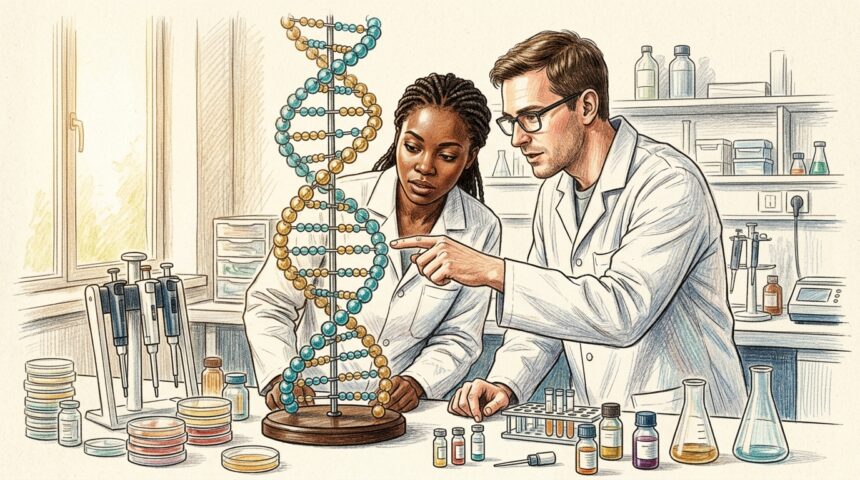
Stowers Institute scientists built a tool that reveals what a DNA model has learned, position by position. Called PISA, the method doubles as a bias detector. It exposed an artifact baked into genomic data and gave the team a way to scrub it out.

Attribution sits at the heart of the technique. PISA walks a prediction at one genomic position back to every other base that shaped it, then renders a base-by-base map of the model’s knowledge. The work landed in Nature Communications and went public August 25. Julia Zeitlinger led the study with Stanford’s Anshul Kundaje; Stowers AI Fellow Charles McAnany is the first author.

The lab folded PISA into BPReveal, its latest BPNet-based deep-learning layer. First up was MNase-seq, the standard technique for locating nucleosomes, where DNA coils around histone proteins to form spool-like structures. The assay’s enzyme trims exposed DNA but prefers certain sequences, so the raw data carried two overlapping signals and the model picked up both.

The problem with older attribution tools was compression. They squeezed each base’s influence into a single score, and opposite signals could erase each other. PISA never compresses. The enzyme’s sequence preferences left a telltale pattern stamped across the full-resolution maps. The team isolated that pattern, built a separate network that reproduced the artifact, and subtracted its output. What remained was a network shaped by biology alone.

With the artifact gone, PISA found sequences that help place nucleosomes, their influence stretching hundreds of base pairs on either side, often unevenly. The lopsided influence flagged chromatin domain boundaries, regions normally charted with expensive 3D sequencing. Zeitlinger likened the added visibility to super-resolution microscopy, where more pixels reveal structure that was always there.

TAGGED:deep learningDNA modelsGenomicsinterpretabilityNature CommunicationsStowers Institute
SOURCES:Unite.AI
Share This Article
Facebook Copy Link Print
MedSpark Staff
Bymsadmin
Follow:
Medical, Healthcare, & Biotech/Pharma AI News

You Might Also Like

News & AlertsSpotlight

Sage Healthspan Launches AI-Powered Precision Health App With Privacy-First Design

By
Yu Chi Huang
June 27, 2025
News & Alerts

Remote care platform HealthSnap banks $25M to widen AI reach

By
msadmin
August 9, 2026
News & Alerts

Amae Health folds Google wearable signals into mental health care

By
msadmin
August 6, 2026
News & Alerts

AI maternity startup Millie joins UCSF Health’s care network

By
msadmin
August 10, 2026

AI news, analysis, and insights for healthcare, biotech, and pharma.

Facebook Twitter Youtube Linkedin
Quick Links
  • News & Alerts
  • Articles
  • Spotlight
  • Events
About Medspark
  • Mission
  • Services
  • Contact

© Copyright 2026 MedSpark. All rights reserved.

Privacy Policy | Legal