
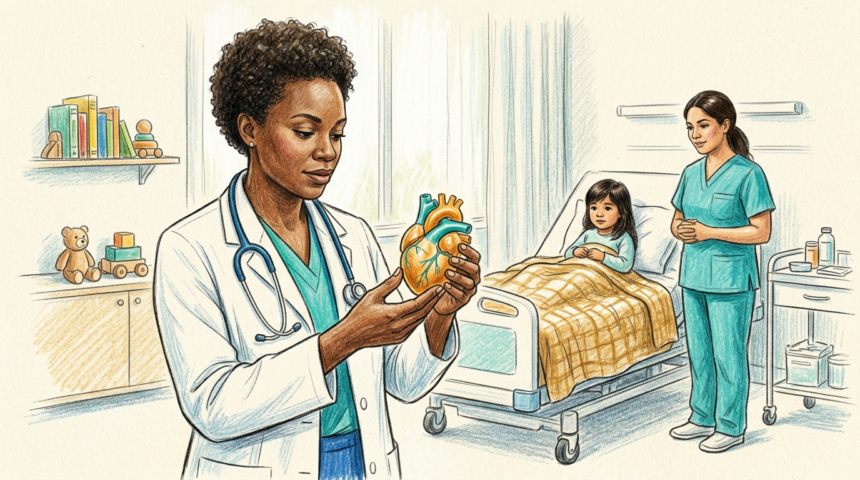
Children’s Hospital of Philadelphia runs a service that turns scans a child already has into precise 3D models of that child’s heart. Each model now takes seconds to produce. The old workflow consumed about four hours of a trained researcher’s day.
The service is built on MONAI. That open-source medical imaging framework was cofounded by NVIDIA and more than 30 institutions. CHOP’s lab uses MONAI Label for annotation, plus NVIDIA’s Auto3DSeg implementation for segmentation. Networks learn from pairs of prior images and the finished models they yielded.
Anatomy is why the speed matters. Roughly 1 in 100 live births involves a congenital heart defect. No two defects look alike, and surgical devices are built for a generic patient rather than a particular child.
Dr. Matthew Jolley, a CHOP cardiologist and researcher, described the mismatch between a one-of-a-kind child and an off-the-shelf device. Modeling, he said, lets the team settle the fit before surgery begins.
Jolley arrived at CHOP in 2015 and helped build SlicerHeart, an extension of the open-source 3D Slicer software. His team now trains a model once it has 10 or 20 image-model pairs. Modeling moved from a specialist research job to a routine clinical step.
Other centers have followed. Cardiac modeling now runs at more than 20 U.S. children’s hospitals, and Jolley’s group shares its methods openly. CHOP’s target for 2026 is about 200 modeled cases, and the hospital wants the tools to reach other specialties.