

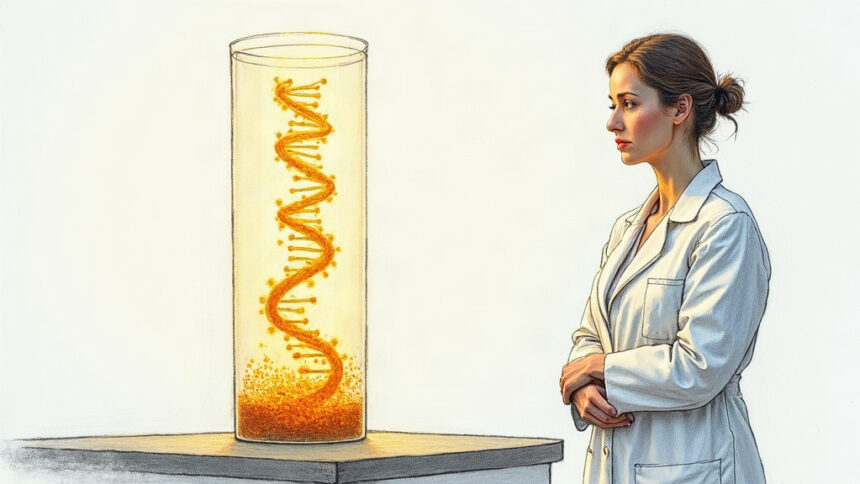
Google DeepMind has unveiled SynthID Bio, a watermarking system that hides a verifiable signature inside proteins designed by AI while leaving their biological function intact.
The mark lives in two places at once: the chain of amino acids that defines a protein, and the predicted 3D shape it folds into. Earlier schemes survived only inside digital files. This one can be read off the physical molecule once it has been synthesized in a lab.
DeepMind built the test around AlphaProteo, its binder design method, and a SynthID Bio-enabled version of ProteinMPNN, a common sequence generator.
Bench assays covered three targets. The marked designs performed as well as unmarked ones, and DeepMind reported no meaningful loss of function, a requirement if such molecules are ever to become medicines.
The motivation is biosecurity. Generative tools such as AlphaFold and AlphaProteo produce novel proteins faster than screening systems can track, and unlabeled synthetic structures risk polluting public databases. A detectable signature would help repositories and DNA-synthesis screening programs separate machine-made molecules from natural ones.
Outside researchers call the idea useful but incomplete. RAND biosecurity scholar Steph Guerra said watermarking can support reproducibility while also delivering a security benefit. Biosecurity researcher Tessa Alexanian noted that a determined user can strip the mark by re-running a watermarked protein through another design tool. She described the method as one layer in a broader defense, and said the field is in a wild new world.